

The most overlooked asset in hostel operations is not the beds, the location, or the marketing budget. It is the staff. Yet most independent hostel operators struggle with hostel staff management — unable to find reliable candidates, unable to train quickly enough, and struggling to build a team culture that drives occupancy and reviews. This creates a vicious cycle: inconsistent recruitment, slow onboarding, fluctuating guest experience, lower reviews, weaker OTA ranking, and ultimately lower occupancy.
After 20 years operating hostels across eight European cities, we have learned that staff quality is the lever that moves everything else. A hostel with exceptional staff, mediocre marketing, and a modest location will consistently outperform a hostel with poor staff, exceptional marketing, and an excellent location.
This is because staff are the product — their energy, their social facilitation, their attention to guests — is what separates a hostel from a building with beds.
This guide covers the full hostel staff management lifecycle: where to find candidates who understand hostel culture, how to hire for attitude rather than CV, how to train new staff in accelerated timeframes, and how to build a team dynamic where staff feel part of a lifestyle, not just a job.
Why hostel staff management is completely different from hotel staffing
Before diving into tactics, it is worth understanding the structural differences between hostels and hotels that make staffing strategies completely different.
Staff is the product in hostels, not the service delivery mechanism
In a hotel:
- Guests spend 70% of time in private rooms
- Interaction with staff is functional (check-in, maybe a question at desk, housekeeping)
- The room, amenities, and facilities are the primary experience
- Staff competence matters, but staff personality is secondary
In a hostel:
- Guests spend 40–60% of time in shared spaces (common room, kitchen, dining area)
- Guests interact constantly with staff — throughout the day, at activities, during socialising
- Staff energy, warmth, social facilitation skills are a core part of the experience
- Staff don’t disappear after their shift: they become friends with guests, join activities, maintain relationships
This is the critical insight: a hostel with mediocre beds but excellent, warm, social staff will outperform a hostel with excellent beds and mediocre staff. The staff IS the hostel.
The hostel staff model: lifestyle, not career
Hotel staff: many are local, seeking career stability, interested in promotion within the property or company. Age range: 25–55, with significant portion 40+.
Hostel staff: younger travelers (18–35) who treat hostel work as integral to a lifestyle of travel and adventure. They work 6–12 months, take 2–4 months traveling, then return to work at same or different property. They build genuine friendships with guests and team members. Work and social life blend.
This is not a weakness. It is the strength of the model. Constant influx of new people = constant new energy, fresh ideas, different perspectives. Staff rotation within your chain = cross-pollination, learning best practices across properties, building a network culture.
The reality: Annual staff turnover in independent hostels is high (60–80% industry average). At Onefam, we have significant rotation, but it is intentional and positive. We have structured it so new staff bring energy, experienced staff move between properties sharing knowledge, and people return after travel with renewed commitment.
Hiring for vibe, not just CV
Hotel: resume, experience, certifications are primary filters. Personality is a bonus.
Hostel: vibe is essential. A candidate with perfect hospitality CV but cold, guarded personality will fail in a hostel. A candidate with no formal experience but warm, curious, socially confident personality can be excellent.
Many hostel owners make the mistake of hiring based on experience. Then they are shocked when experienced person does not fit the culture and leaves within weeks.
The real impact of staff quality on revenue and operations
Understanding the true impact of staff quality — and how fast training enables quality — motivates investment in better hiring and team building.
Staff quality directly drives every revenue metric
Staff affect every revenue metric:
Occupancy: Good staff → better reviews → higher OTA ranking → more bookings
Average daily rate (ADR): Staff that upsells appropriately (private room upgrade, activities, merchandise) → higher ADR
Repeat booking rate: Staff that creates genuine experience and friendship → guests return (zero acquisition cost, pure margin)
Direct booking rate: Guests who have good staff interaction → book direct next time instead of OTA (zero commission, 100% margin)
Length of stay (ALOS): Staff that facilitates social connection and activities → guests extend stay, recommend friends
Negative review mitigation: Staff that handles complaints well → complaint never becomes negative review
Compare two 60-bed hostels in identical location:
Hostel A: Great staff, mediocre marketing
- 85% occupancy
- €22 ADR (staff upselling works)
- 18% repeat rate
- 20% direct booking rate
- 9.4 average review score
- €62 RevPAB
Hostel B: Mediocre staff, great marketing
- 70% occupancy
- €18 ADR (no upselling, lower rates to fill)
- 4% repeat rate
- 5% direct booking rate
- 7.8 average review score
- €39 RevPAB
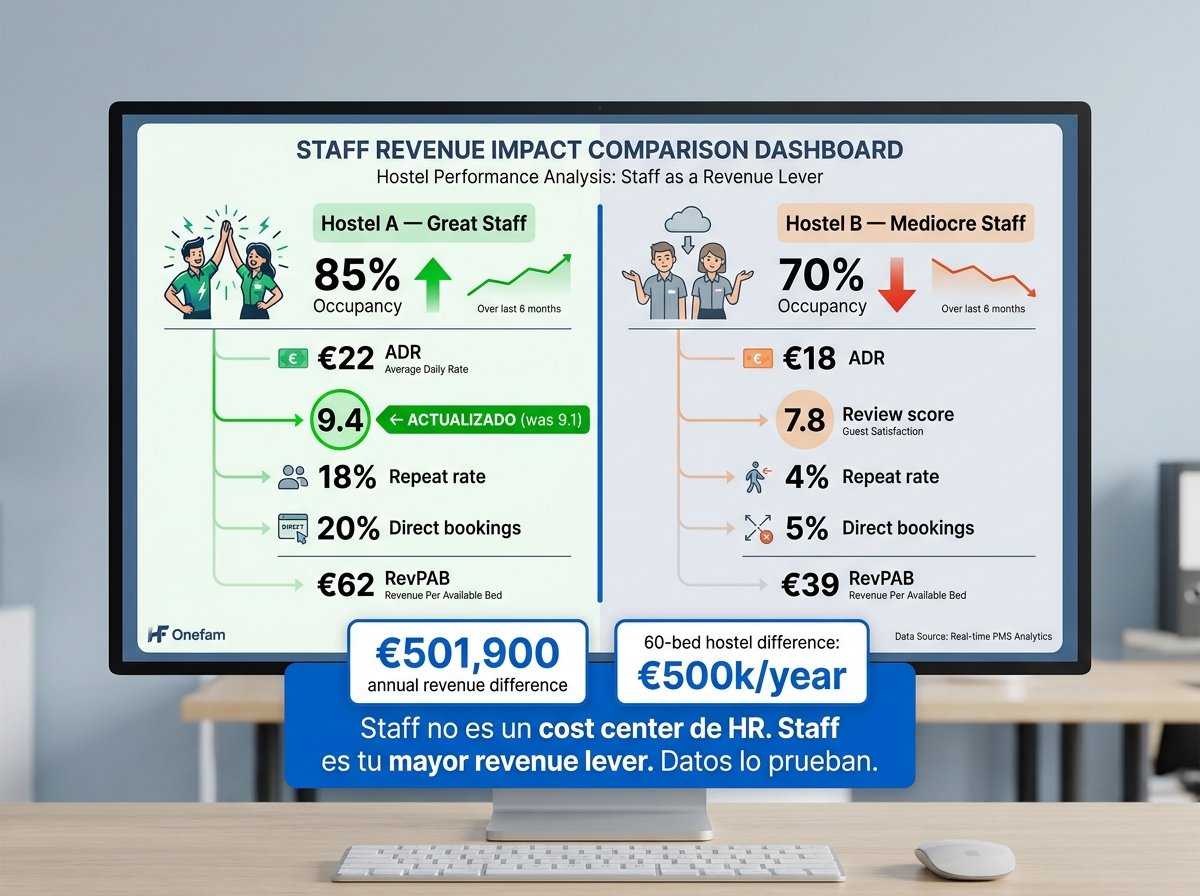
Staff is the revenue lever. Difference in annual revenue: 60 beds × (€62–€39 RevPAB) × 365 days = €501,900 per year.
The advantage of fast training systems
When you have rapid, structured training (3–5 days vs. 2–3 weeks), new staff reach productivity faster. This means:
- Consistent guest experience even with high turnover
- Lower occupancy drops during transition periods
- New staff feel confident and supported (reduces early-stage turnover)
- You can hire based on attitude, knowing systems will train the skills
Where to find hostel staff that will actually fit
Most hostel owners advertise on wrong platforms and attract wrong candidates.
Wrong place: traditional job boards
Indeed, LinkedIn, Glassdoor: these platforms attract candidates seeking formal “job” with structure, benefits, career path. They expect weekday hours, standard employment contract, growth opportunities.
When these candidates interview at hostel and understand the reality (irregular hours, transient team, informal structure, travel-focused culture), expectation vs. reality mismatch surfaces. They leave within weeks.
Right place: hostel-specific and backpacker networks
Instagram and social media (best ROI currently):
- Post on Instagram Reels and Stories: “Now hiring for [role] — join our team!”
- Tag backpacker influencers and travel accounts
- Use hashtags: #BackpackerJobs #HostelWork #TravelAndWork #[CityName]HostelJobs
- Stories show daily life at hostel (real engagement, not polished)
- DMs: candidates message directly after seeing lifestyle content
Instagram is where young travelers live. Job postings with photos of team, daily life, activities get engagement.
Facebook groups (secondary, still valuable):
- “Backpackers looking for work [region]”
- “Work and travel [specific city]”
- Regional job exchange groups
Word of mouth (highest quality):
- Current staff recommending friends
- Guests who stayed and loved the vibe asking if there are jobs
- Staff who left temporarily (travel) returning because they miss the community
Offer small bonus (€100–200) to staff for referrals that lead to hires.
Hostel-to-hostel transfers within your chain (highest retention):
- Staff at Barcelona property wanting to experience Madrid or Amsterdam
- Staff return from travel wanting to come back
- Rotation within network builds chain culture and retains good people
Walk-ins and guests: Unconventional but very effective: guest loves the vibe, asks if you are hiring. This person already validated that they love hostel environment. Many of best staff come this way.
Community and local networks:
- Local universities and international student networks (part-time workers)
- Nomad/digital creator communities (flexible people)
- Local travelers and backpackers in your city
Where NOT to look
- Hospitality recruitment agencies (oversell formal structure, attract wrong demographic)
- Craigslist (attracts wrong profile)
- Hotel recruitment (highest mismatch: hotel staff used to formal structure, hierarchy, service standards; transition to hostel culture usually fails)
Hiring for attitude: the interview and selection playbook
The goal of hiring is not to find someone with perfect CV. It is to find someone whose attitude, personality and values align with hostel culture and lifestyle. Skills can be taught in days. Attitude and culture fit, if wrong, never change.
Step 1: Design interview to assess vibe and lifestyle alignment, not competence
Bad question: “Tell me about your experience in hospitality.”
Better question: “What are your favorite and least favorite hostels you have stayed in, and why?”
This reveals:
- Whether they understand hostel culture (have they actually stayed in them?)
- What they value (social experience? Cleanliness? Location? Outdoor activities?)
- How they articulate opinions and observations
- Whether they think critically about environments
- If they are a traveler or just looking for a job
If they light up talking about “amazing events, super friendly staff, and I made lifelong friends there” = perfect fit. If they say “quiet, clean, private bathroom” = they might be looking for a job, not a lifestyle.
Step 2: Conduct interview in the hostel during operations
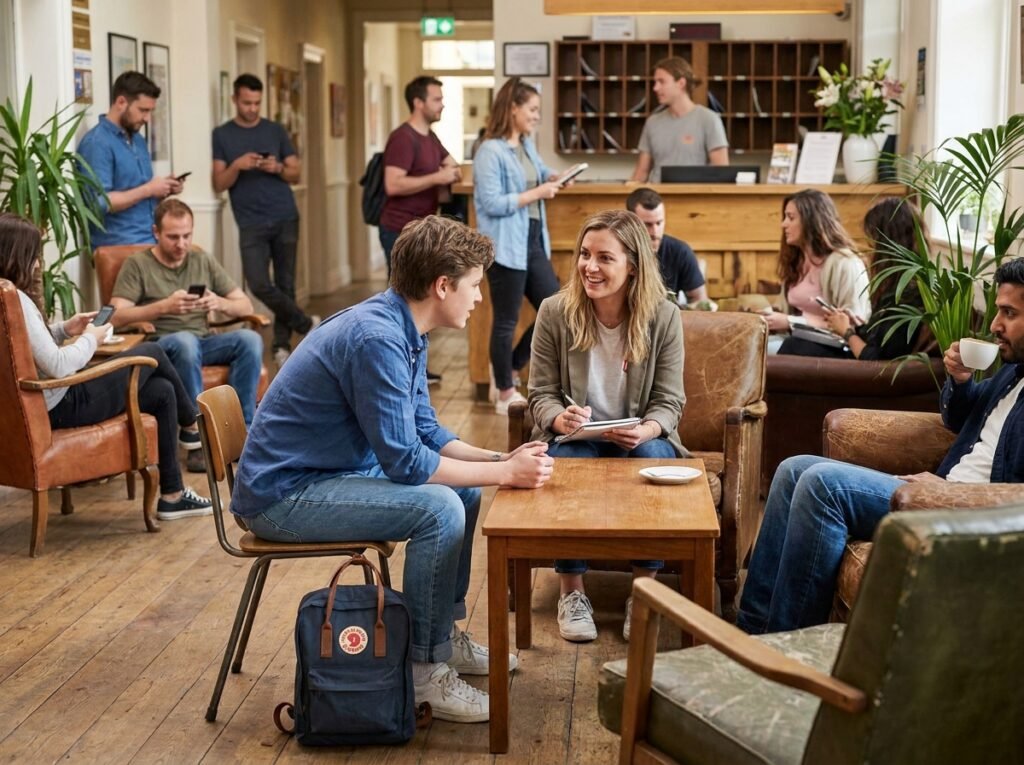
Do NOT interview only in quiet office.
Bring candidate into common area during operation (check-in time is ideal, or evening activity). Observe:
- Can they focus with noise and activity, or are they overwhelmed?
- Do they naturally engage with guests or seem awkward?
- Do they smile, make eye contact, seem energized?
- Do other staff gravitate toward them or seem wary?
- How do they handle seeing guests arrive stressed, needing help?
Behavior in actual environment >> prepared interview answers.
Step 3: Assess specific soft skills
Genuine interest in people: “Tell me about a time you made someone new feel genuinely welcome or helped create connection.”
Hostels need natural connectors who care about people, not just service procedures. This reveals whether candidate is naturally social or more reserved.
Adaptability: “Tell me about something you did not know how to do, and how you learned it.”
Looking for: coachability, resilience, willingness to figure things out, positive attitude. Candidates who blame external factors vs. taking ownership.
Comfort with travel lifestyle: “What draws you to want to work in a hostel? What do you hope to do while you are here?”
Listen for: Are they genuinely interested in travel and community? Are they using hostel as stepping stone? Are they looking for stable long-term role (red flag)? Do they want to build friendships and experiences?
Cultural fit: “If you were hanging out with guests on your day off, what would you do?”
Are they willing to blur the line between work and social life? Can they be staff AND friend? Will they participate in team activities and guest events?
Step 4: Include current staff in evaluation
Involve one or two current staff members in interview or at least brief meet.
Current staff sense vibe mismatch that you cannot. They are the ones working alongside new person, so their buy-in matters.
Key question to current staff: “Would you want to work your shift with this person? Would you hang out with them on your day off?”
Staff instinct about fit is predictive of success.
Step 5: Reference checks from hostel backgrounds
If candidate has worked another hostel: call previous manager. Ask specifically:
- Would you hire them again?
- What was their strongest quality?
- Did they build genuine relationships with guests and team?
- Did they participate in social activities and team culture?
- Why did they leave?
Hostel-to-hostel reference is gold. Previous manager understands the role and culture.
Step 6: Paid trial shift (if possible)
Offer 1–2 paid trial shifts (4–6 hours each) before formal hire. Candidate works actual shift with your staff and guests.
This is better than any interview because you see them actually in the role, under real conditions, with guests present, with your staff watching.
If candidate cannot handle a 4-hour trial shift, they will not handle full employment.
Training new hostel staff: the accelerated system
Training must be FAST because occupancy pressure is constant and new staff need to contribute quickly.
Day 1: Brand, culture, lifestyle orientation
Morning: Walk new hire through entire hostel (every room, all common areas, kitchen, office). Explain the vibe: “We are not just a place to sleep. We are a community. Staff are part of the experience. Our job is to facilitate connection, make guests feel like they belong, and create an environment where people make friendships and memories.”
Cover: PMS basic login and functions (check reservations, understand bed status), emergency procedures (fire, medical, security), data protection rules.
Critical: explain the WHY. Not “do this” but “we do this because it affects guest experience and their decision to come back.”
Afternoon: Shadow experienced receptionist during evening shift (typically 3–7pm, peak check-in time). New hire observes, does not do tasks yet. Just watch and listen. Notice how staff greets guests, builds rapport, recommends activities.
End of day debrief: What questions do you have? What felt overwhelming? What excited you? What are you confident about?
Day 2: Expanded observation across different shift
Shadow different shift (if day 1 was evening, do day shift). Daytime has different rhythm: housekeeping coordination, guest questions, maintenance issues, slower check-ins. Evening has fast check-ins, social activities, community events.
By end of day 2, new hire has broad understanding of full operational day and community functions.
Day 3: Guided execution with support

New hire now does actual tasks (check-in, guest communication) with experienced staff present as safety net. Experienced staff watches, corrects, affirms.
“You check this guest in. I am here if you have questions.” New hire feels real responsibility but supported.
By end of day 3, new hire should have completed 5–10 check-ins with guidance and feel confident at basic mechanics.
Day 4: Independent shift with supervision available
New hire operates mostly independently with experienced staff available by phone or in building (not hovering). First independently managed shift.
Manager available for escalations. But new hire is the point person.
Day 5: Troubleshooting and edge cases
Dedicated training on: difficult guests, payment issues, maintenance emergencies, guest conflicts, complaint handling, activities coordination.
Run through scenarios: “Guest arrives and we have no record of reservation. What do you do?” “Two guests in a dorm are fighting over noise. How do you handle it?”
Day 6: Systems and backend operations
Training on: PMS advanced features, OTA connections, documentation, how to request reviews from guests, how to escalate to manager, proper communication channels.
Day 7: Review, integration, and community participation
Formal review: what went well? What needs clarification? Any lingering concerns?
Integration into team: introduce socially, clarify scheduling, explain team dynamics. Invite to next team meal or social activity.
By end of day 7: new hire is live, independent, still ramping but capable.
Key requirement for fast training: SOPs must be documented. Without documentation, training extends to 2–3 weeks because you are explaining same procedures multiple times.
Building team culture: where the real retention happens
High staff rotation is natural in hostels. But you can dramatically increase the quality of people who stay, return, or refer friends.
Strategy 1: Treat work as lifestyle, not job
Staff stays and returns when they feel like they are part of a community and lifestyle, not just working.
This means:
- Staff and guests socialize together (not forbidden, but encouraged)
- Team hangs out on days off together
- Social activities and events are led/organized by staff (programming is their responsibility)
- Staff get “free” membership to hostel and can use spaces
- Travel opportunities and schedule flexibility are built in
Strategy 2: Rotate staff within your chain strategically
If you operate multiple properties: rotate good staff between them. This:
- Prevents burnout from same environment
- Builds chain-wide culture and best-practice sharing
- Gives staff travel opportunity while keeping them in network
- Facilitates return-hires (people leave knowing they can come back to different property)
Staff who leave after 6–12 months knowing they can return to a different Onefam property and continue the lifestyle/community are far more likely to stay active in your ecosystem than staff forced to choose between “stay in same property forever” or “leave completely.”
Strategy 3: Create pathways for travel + return
Make it clear that taking 2–4 months off to travel and returning is not viewed as “quitting.” It is viewed as part of the hostel lifestyle.
- “Take your leave, travel, then come back when you’re ready”
- “Work 6 months, travel 3 months, work 6 months again”
- Create alumni network of people who cycle through
This builds a community of ambassadors who have worked for you, left, returned, and bring energy each time they come back.
Strategy 4: Build genuine friendships between staff and guests
This is unique to hostels. The boundary between staff and guest should be porous:
- Staff participate in guest activities and social events
- Staff recommendations for local activities, food, nightlife come from genuine experience
- Staff maintain connections with guests after they leave (social media, messages)
When staff see themselves as part of guest experience (not separate service providers), they care more, perform better, and stay longer.
Strategy 5: Operational autonomy
Trust staff to make decisions:
- Approve room moves without asking manager
- Comp a late checkout if guest has legitimate reason
- Organize activities if inspiration strikes
- Make decisions about guest problems within reasonable bounds
Staff that feels micromanaged leaves. Staff that feels trusted stays and performs better.
Strategy 6: Competitive compensation
In competitive cities (Barcelona, Amsterdam, London, Prague), below-market wages create friction.
Research what other hostels in your city pay. Pay at or slightly above market. This ensures you are competing on culture and lifestyle, not losing good people to €200/month wage differential.

Strategy 7: Community and celebration
Regular team meals, post-shift hangouts, celebration of milestones, honest communication about business.
Staff that feels like part of a community (not just employees) stays longer and refers friends. Creates psychological contract beyond compensation.
Red flags in hiring and when to cut losses
Some hiring mistakes become obvious quickly. Know when to cut losses.
Hiring red flags (interview stage)
- No interest in travel or hostel lifestyle (just “needs a job”)
- Introverted or guarded in interview (wrong vibe for community-based role)
- Complained extensively about every previous job (pattern vs. unlucky situation)
- Asked ZERO questions (not genuinely interested in role or hostel)
- Late to interview without communication (predicts behavior during employment)
- Dismissive of hostel culture or concept (“Why would anyone want to share a room?”)
If multiple red flags appear in interview, do not hire. Trust your instinct.
Early employment termination triggers (first 1–2 weeks)
- Consistently late or missing shifts without communication
- Rude, dismissive, or unprofessional with guests (non-negotiable)
- Under influence (drunk, high) during shift
- Violating security procedures (not locking doors, sharing access codes)
- Refusing to follow basic SOPs or hostility to feedback
- Disruptive to team (gossip, drama, undermining other staff)
Early termination is painful but necessary. Keeping wrong person longer costs more in occupancy loss, reputation damage, team morale.
Better to cut losses in week 1 than have someone damage reputation or team culture for three months.
The reality: staff management is the revenue lever
Why staff quality matters more in hostels than almost any other business.
Hostels are fundamentally about human connection, experience, and community. Staff create that. Marketing, location, and facilities are secondary.
Staff affect every revenue metric:
Occupancy: Good staff → better reviews → higher OTA ranking → more bookings
Average daily rate (ADR): Staff that upsells appropriately (private room upgrade, activities, merchandise) → higher ADR
Repeat booking rate: Staff that creates genuine experience and friendship → guests return (zero acquisition cost, pure margin)
Direct booking rate: Guests who have good staff interaction → book direct next time instead of OTA (zero commission, 100% margin)
Length of stay (ALOS): Staff that facilitates social connection and activities → guests extend stay, recommend friends
Negative review mitigation: Staff that handles complaints well → complaint never becomes negative review
Compare two 60-bed hostels in identical location:
Hostel A: Great staff, mediocre marketing
- 85% occupancy
- €22 ADR (staff upselling works)
- 18% repeat rate
- 20% direct booking rate
- 9.4 average review score
- €62 RevPAB
Hostel B: Mediocre staff, great marketing
- 70% occupancy
- €18 ADR (no upselling, lower rates to fill)
- 4% repeat rate
- 5% direct booking rate
- 7.8 average review score
- €39 RevPAB
Staff is the revenue lever. Difference in annual revenue: 60 beds × (€62–€39 RevPAB) × 365 days = €501,900 per year.
A hostel with great staff, mediocre marketing, and average location: 85% occupancy, €62 RevPAB, 9.4 reviews.
A hostel with great marketing, great location, and mediocre staff: 70% occupancy, €39 RevPAB, 7.8 reviews.
The difference is €500k+ annual revenue. Staff is the lever.
When to outsource staff management
At some point, managing recruitment, culture building, training, and team development becomes a bottleneck for owner.
Signs you should explore outsourced staff management:
- You are spending 10+ hours per week on recruitment, hiring, team issues
- You have 2+ properties and cannot maintain culture consistency across teams
- Staff instability is the constraint preventing growth
- You want to scale but culture dilution is the risk
Professional hostel management companies have:
- Tested recruitment processes and networks across multiple markets
- Standardized, accelerated training programs (consistent quality, faster ramp)
- Culture-building expertise proven across portfolios
- HR infrastructure, compliance, payroll management
- Community and network effects across multiple properties
This typically costs 5–10% of payroll but improves culture, reduces reputation issues, and increases repeat bookings due to consistent staff quality.
Conclusion
Staff is the product in hostels. Everything else — SOPs, revenue management, guest experience — depends on having quality people who understand and embody hostel culture and lifestyle.
The difference between a hostel that scales profitably and one that stagnates is usually not market, product, or location. It is whether you have built a culture and systems that attract the right people, train them quickly, and create an environment where they want to stay, return, or refer friends.
If you are operating one hostel and struggling to build a strong team, investing now in better hostel staff management systems — particularly in hiring for culture fit and building team lifestyle — is the investment that compounds most.
If you are operating multiple properties and want to scale without diluting culture, that is the inflection point where exploring professional hostel management services — specifically the cultural infrastructure, recruitment networks, and team-building expertise — can be transformative for your business.
Frequently asked questions
What makes hostel staff management different from hotel staffing?
In hotels, staff is one part of the service delivery system. In hostels, staff IS the product — their energy, personality, and social facilitation creates the core experience. Hotel staff are service providers; hostel staff are community builders. Additionally, hostel staff often treats work as part of a travel and lifestyle experience, not as a career path, which requires completely different retention and culture strategies.
Where should you look to hire hostel staff today?
Instagram and social media (Reels, Stories, hashtags) reach backpackers and travelers directly. Word of mouth from current staff and guests is highest quality. Hostel-to-hostel transfers within chains build culture. Avoid traditional job boards (Indeed, LinkedIn) which attract candidates seeking formal employment structure — the opposite of hostel culture.
How do you interview candidates for hostel positions?
Interview for cultural fit and lifestyle alignment, not CV. Ask “What are your favorite and least favorite hostels you have stayed in?” to gauge understanding. Conduct part of interview in the hostel during operations so you observe how candidate responds to activity, guests, and environment. Include current staff in evaluation. Reference checks from previous hostel work are gold.
How long does it take to train new hostel staff?
With documented SOPs and structured mentoring, new staff can be independent within 5–7 days. Without SOPs, training takes 2–3 weeks. The accelerated system includes day-by-day progression from observation to guided execution to independence.
What actually drives hostel staff to stay?
Culture, community, and lifestyle opportunity matter far more than wages alone. Staff stays when they feel part of a community (not just employees), when given schedule flexibility for travel, when treated as friends not subordinates, and when the work is part of a larger lifestyle, not just a job. Rotation within a chain and ability to return after travel are also powerful retention tools.
Onefam Hostels manages 19 properties across eight European cities. We intentionally hire young, energetic staff who treat hostel work as part of a travel lifestyle. Our high staff rotation is a feature, not a bug — it brings constant new energy while our culture and training systems ensure consistency. We maintain 9.4 average review scores and 86% occupancy driven significantly by staff quality and cultural alignment. If you are exploring how professional hostel management services build and maintain strong hostel cultures across multiple properties, contact us at partnership@onefamhostels.com.








2 Responses