

Most hostel owners don’t fail because they chose the wrong location or built the wrong product. They fail — or plateau — because they never built the right operating system around it. How to manage a hostel?
After 20 years managing hostels across eight European cities — Barcelona, Madrid, London, Prague, Porto, Amsterdam, Budapest and Seville — we have a very clear picture of what separates a hostel running at 65% occupancy from one running at 86%. It is rarely the beds, the décor or the neighbourhood.
It is the discipline of operations: documented processes, data-driven revenue decisions, trained and retained staff, and a guest experience built deliberately rather than left to chance.
This guide covers all of it. Not as a theoretical framework, but as the system we use across 19 properties every day.
The two things that silently kill hostel performance
Before diving into tactics, it is worth naming the two structural problems that explain most underperforming hostels.

The first is the absence of documented operating procedures. When how things get done lives only in the heads of a few long-term staff members, consistency becomes impossible. A guest who checks in on Tuesday gets a different experience from one who checks in on Friday.
Standards fluctuate with whoever is working. Reviews reflect that inconsistency — and on platforms like Hostelworld and Booking.com, a drop from 9.0 to 7.5 can directly cost 10–20 percentage points of occupancy. The process is the product, and if the process is not written down, it does not exist at scale.
The second is reactive revenue management. The overwhelming majority of independent hostels set a seasonal price table at the start of the year and adjust it rarely. This means leaving significant money on the table during periods of high demand and haemorrhaging beds during soft periods because the pricing was not adjusted in time.
Hostel revenue management is not a strategy for large chains — it is a competitive necessity for any property that wants to close the year in profit.
Fix these two things and almost everything else becomes easier.
Hostel operations management: the daily systems that matter
Front desk and reservation management
The front desk is the most visible part of hostel operations, but it is also the area where the most operational debt accumulates. Check-in queues, double bookings, unanswered messages and missing reservation notes are symptoms of a system problem, not a staffing problem.

A well-managed front desk runs on three things:
A cloud-based Property Management System (PMS). The PMS is the central nervous system of your hostel. It handles room assignments, reservation history, payment processing and — if properly integrated — channel synchronisation. Choosing a PMS designed for hostels (rather than adapted from hotel software) matters: bed-level inventory management, dorm configuration, group booking handling and OTA connectivity are meaningfully different from hotel requirements.
Pre-arrival communication sequences. A guest who receives a confirmation email, a pre-arrival message with practical information and a check-in link is a guest who arrives prepared. This reduces friction at front desk, decreases the number of questions staff need to answer manually and improves the first impression before the guest has even walked through the door. Most PMS systems support automated pre-arrival messaging — use it.
A documented check-in and check-out SOP. Every step of the check-in process — from verifying the booking to assigning the bed, collecting payment and explaining facilities — should be documented, tested and trained to new staff within their first two shifts. If it takes a new staff member three weeks to run a smooth check-in independently, the SOP is not clear enough.
For group bookings — a high-value segment that many independent hostels handle poorly — the process should be separate: dedicated contact point, pre-rooming list, payment schedule and a day-before confirmation call. Groups handled professionally leave better reviews and book again.
Housekeeping and maintenance standards
Cleanliness is the single attribute most directly correlated with review scores. It is also the area where standards are hardest to maintain consistently, particularly in high-turnover operations.
At Onefam, every hostel runs daily room inspections against a standardised checklist. The checklist is not optional and it is not informal — it is a structured document tied to room status in the PMS. A room does not change status from dirty to clean until the checklist has been completed and signed off.

The practical structure for hostel housekeeping:
- Morning turnover: dorm rooms cleared and cleaned after late check-outs, beds remade to standard, lockers checked, floors swept and mopped.
- Common area rounds: reception, lounge, kitchen and bathrooms checked and cleaned on a timed rotation, not reactively. In a busy hostel, common bathrooms need attention every 90–120 minutes during peak hours.
- Preventive maintenance log: every reported issue — broken locker, faulty light, dripping tap — enters a log with a target resolution time. Minor issues resolved within 24 hours, anything affecting guest comfort within four hours. An unresolved maintenance issue that a guest mentions in a review is an issue that was logged and not prioritised.
The relationship between housekeeping and revenue is direct and measurable. Properties with review scores consistently above 9.0 average significantly higher occupancy than those between 7.5 and 8.5 — because OTA ranking algorithms weight scores heavily and because guests filter by rating.
Guest experience management
Guest experience in a hostel is not the same as hotel service. It is not about concierge recommendations or turndown service. It is about atmosphere, connection and the feeling that there is something alive in the building.
The hostel experience starts at check-in and continues through every interaction. A staff member who gives genuine local recommendations, remembers a guest’s name on day two, organises a spontaneous activity or defuses a dormitory tension before it becomes a complaint is doing more for your revenue than any OTA campaign.
Structurally, this means:

Programming. Even minimal programming — a weekly family dinner, a city walking tour, a pub crawl with staff — creates the social infrastructure that turns a building with beds into a hostel. Guests at a socially active hostel extend their stays, leave better reviews and refer others. The cost is almost always lower than the revenue uplift.
Review management. At checkout, every guest should receive a request to leave a review on Booking.com or Hostelworld. This is not optional. The hostels in our chain that actively request reviews receive 40–60% more reviews than those that don’t — and more reviews statistically correlate with a higher average score. On the platform side, every negative review warrants a response within 48 hours: professional, specific and solution-focused, never defensive.
Complaint resolution. A guest complaint handled well in the moment rarely becomes a negative review. A complaint ignored almost always does. Train staff on a simple framework: acknowledge, apologise, act. Do not escalate for minor issues. Empower front desk staff to solve problems without needing manager approval for small gestures — a late check-out, a locker issue resolved, a room move.
Hostel revenue management: the part most owners get wrong
This is the area where independent hostel operators most consistently leave money on the table, and the gap between managed and unmanaged properties is widest.
Dynamic pricing vs static pricing
Static pricing — a seasonal rate table set in advance and adjusted rarely — is the default for most independent hostels. It is also the reason many of them underperform relative to their market potential.
Dynamic pricing means adjusting your rates in response to real-time signals: current occupancy across your own inventory, competitor pricing, local demand events, lead time to arrival and day-of-week patterns. A hostel with 200 beds does not need enterprise-level software to do this — it needs a clear methodology and the discipline to review and adjust rates daily.
A concrete illustration: imagine a 60-bed hostel in a European city. In a normal week, it runs at 78% occupancy at an average bed rate of €22. A major music festival is announced six weeks out. Without a pricing response, occupancy fills to 95% at the same €22 rate — technically successful, but significantly underpriced.
A property with a dynamic pricing approach would detect the demand signal early, raise rates incrementally as occupancy fills, and close that week at €32–€36 average rate. The revenue difference on a single week is substantial.
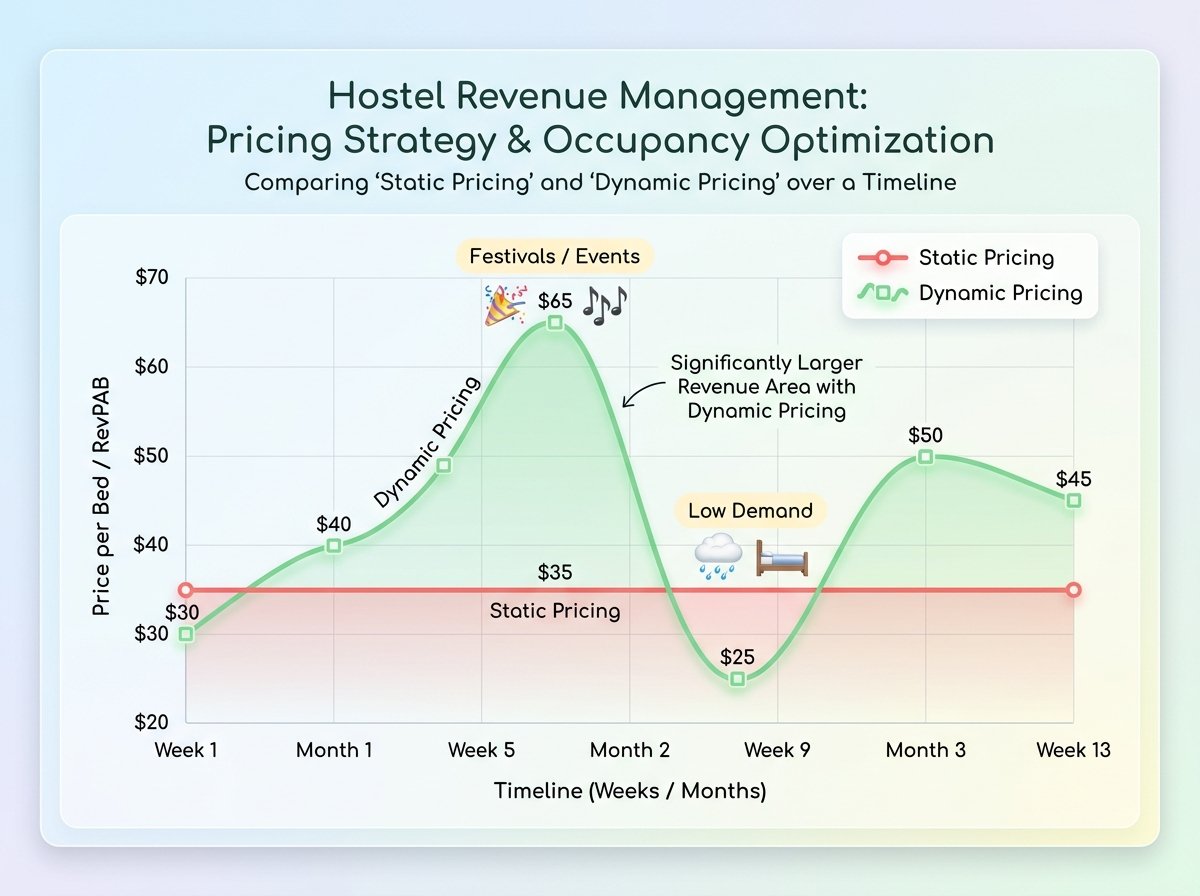
The same logic applies in reverse during low-demand periods. Holding a rate of €22 when the market is soft and you are running at 55% occupancy is a choice to have empty beds. A targeted reduction — strategic, not panicked — will fill the inventory and maintain the financial baseline.
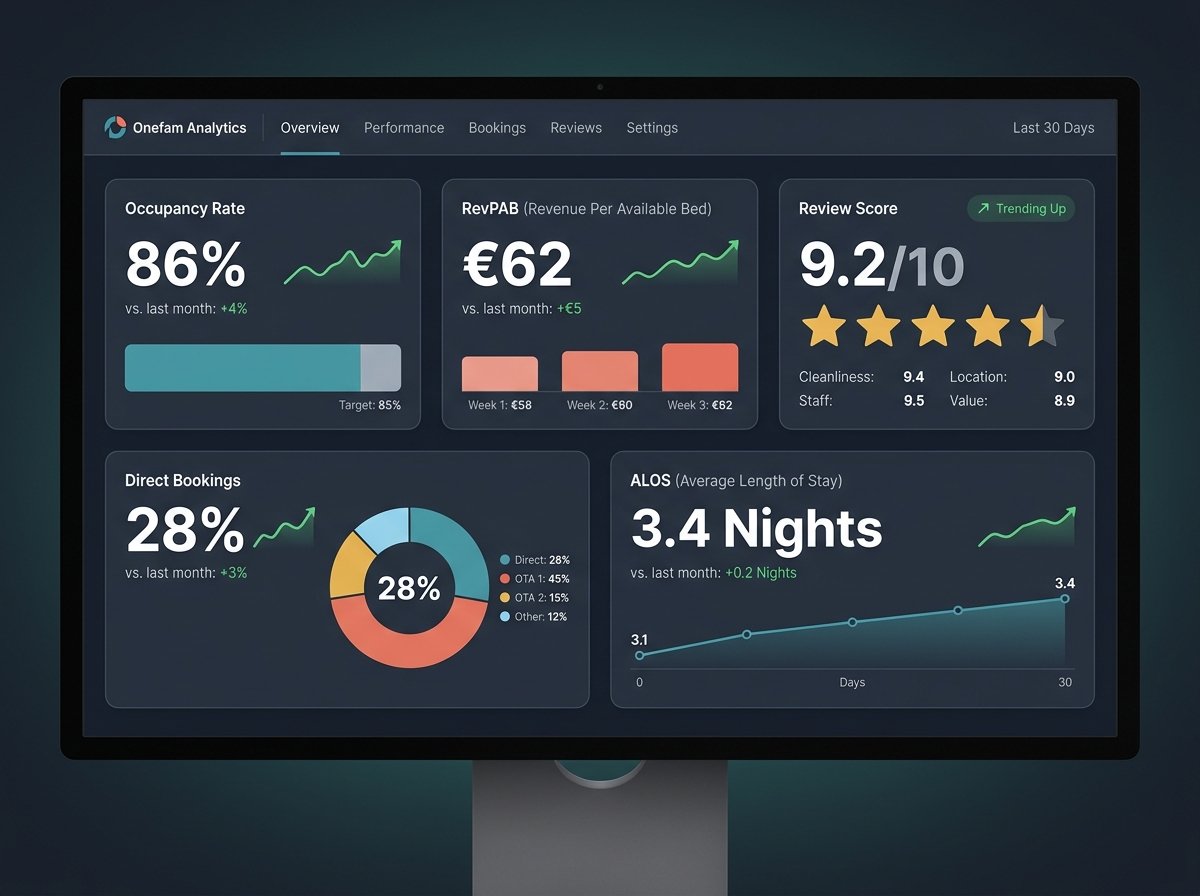
At Onefam, our revenue management department operates as a dedicated internal function. We track pickup pace, competitor rate positioning and local event calendars across all 19 properties. The result is a chain-wide RevPAB of €62 and an average occupancy of 86% — metrics that reflect active management, not passive availability.
Channel mix: OTAs vs direct bookings
Most hostels are over-reliant on a single OTA. This is a structural vulnerability: algorithm changes, commission increases or ranking drops on one platform can meaningfully reduce revenue overnight with no warning.
A healthier channel mix looks something like this:
- Hostelworld: the specialist platform for hostel bookings, with the most relevant demographic. Commission typically 15–22% of booking value. High visibility for hostel-specific searches.
- Booking.com: the highest-volume OTA globally. Commission 15–18%. Broader audience, including travellers who would not self-identify as hostel guests but are price-sensitive. Strong mobile traffic.
- Direct bookings: zero commission. Lower acquisition rate than OTAs but significantly higher margin. Requires investment in a booking-engine-enabled website, email capture and retargeting strategy. Every percentage point of shift from OTA to direct bookings is a pure margin improvement.
- Expedia/Hotels.com group: secondary volume, worth maintaining for breadth but not a primary focus for most hostel operations.
The goal is not to abandon OTAs — they provide reach and price comparison visibility that a direct booking channel cannot replicate independently. The goal is to use OTAs as acquisition channels and convert repeat guests and email subscribers to direct. A hostel that is 80% dependent on one OTA is one algorithm update away from a revenue crisis.
Occupancy vs rate: when to prioritise each
The tension between filling beds and maximising rate per bed is the central operating question of hostel revenue management, and the answer changes constantly.
As a general framework:
Prioritise occupancy when: you are more than 90 days from the date, you are in a soft demand period, you are in the first 12 months of a property’s operation (reviews and ranking are being built), or your occupancy is below 60% within 14 days of arrival.
Prioritise rate when: occupancy is tracking above 80% more than 30 days out, local demand events are driving above-average interest, you are in peak season, or last-minute demand is strong (less than 7 days out).
Neither rule is absolute. The skill is in reading the signals accurately and acting on them early enough to matter. A rate increase on a sold-out weekend is not revenue management — it is luck. Revenue management is the decision made six weeks before, when the data told you the weekend would sell out.
Hostel staff management: The lever most owners underestimate
Operational quality in a hostel is a direct function of the people delivering it. This is more true in hostels than in almost any other hospitality setting, because the human interaction — the vibe, the energy, the social fabric — is a core part of the product.
Hiring for attitude, training for skills
The single most common hiring mistake in the hostel industry is weighting CVs over personality. An experienced front desk candidate who is cold, procedural and disengaged will drive worse reviews than an inexperienced candidate who is genuinely warm, curious about people and energised by social environments.

The skills of hostel operations — using a PMS, processing payments, handling group bookings, executing check-in procedures — can be trained in days. The willingness to make a guest feel welcome cannot.
In practice, this means:
- Screening for energy and social confidence in the interview, not just experience.
- Asking candidates to describe a time they turned a difficult guest interaction around, not just their previous job history.
- Running a short working trial if budget allows — how someone performs in the actual environment of the hostel tells you far more than an interview.
- Being clear about what the role actually involves: shifts at unusual hours, high-intensity social interaction, physical tasks. Candidates who are surprised by these realities in week two were not screened honestly.
SOPs: why documented procedures are non-negotiable
Standard Operating Procedures are not bureaucracy. They are the mechanism by which the quality of a hostel becomes independent of which specific staff member is working.
Without SOPs, your hostel’s performance is a function of individual motivation and memory. With SOPs, it is a function of the system. The system can be improved, trained and replicated. Individual motivation cannot be managed at scale.
Minimum SOP coverage for a well-run hostel:
- Check-in procedure (step-by-step, including edge cases: late arrivals, missing reservations, payment issues)
- Check-out procedure (including bag storage, lost property, damage assessment)
- Room cleaning standard (with checklist and photo reference for bed-making standard)
- Common area cleaning schedule and standard
- Complaint handling framework
- Emergency and security procedures
- OTA review request at checkout
- Opening and closing procedures by shift
Each SOP should be a living document: reviewed and updated when processes change, when a new issue is identified, or when a staff member points out a step that does not reflect how the work actually gets done. An SOP that does not match reality is worse than no SOP — it trains staff to ignore documentation.
For a deeper look at building hostel SOPs, see our guide to hostel standard operating procedures.
Staff retention in a high-turnover industry
Hospitality has among the highest staff turnover rates of any sector. In hostels, where many staff members are themselves travellers passing through, this is amplified. Constant turnover has a direct cost: recruitment time, training time, the period during which a new hire is not yet performing at standard, and the cultural disruption of a team that is always being rebuilt.
Practical retention levers:
Career progression visibility. Even in a small hostel, the ability to move from front desk to senior receptionist to assistant manager gives staff a reason to stay. Define the progression criteria explicitly.
Operational autonomy. Staff who are trusted to solve problems without escalating every decision stay longer and perform better. Micromanagement is a primary driver of resignation in hospitality.
Cultural investment. Regular team meals, post-shift gatherings, honest communication from management about how the hostel is performing — these cost very little and signal that the staff are part of something, not just shift workers.
Competitive compensation. In competitive hostel markets, below-market wages reliably produce above-market turnover. The cost of replacing a good front desk staff member — recruitment, training, the performance curve — typically exceeds the cost of the wage gap that drove them to leave.
Hostel KPIs: the metrics every owner should be tracking
Operating a hostel without tracking performance data is operating blind. These are the metrics that matter — with Onefam’s chain-wide benchmarks where applicable.
| KPI | What it measures | How to calculate | Onefam benchmark |
|---|---|---|---|
| Occupancy rate | % of available beds sold | Beds sold ÷ beds available × 100 | 86% |
| RevPAB | Revenue per available bed | Total room revenue ÷ available beds | €62 |
| Average bed rate (ABR) | Average revenue per bed sold | Total room revenue ÷ beds sold | — |
| Review score | Guest satisfaction across platforms | Average of Booking.com + Hostelworld scores | 94% satisfaction |
| Average Length of Stay (ALOS) | How long guests stay on average | Total guest nights ÷ total bookings | — |
| Repeat guest rate | % of guests who have stayed before | Returning guests ÷ total guests × 100 | — |
| Cost per occupied bed (CPOB) | Operating cost per bed sold | Total operating costs ÷ beds sold | — |
| Direct booking rate | % of bookings made direct (no OTA) | Direct bookings ÷ total bookings × 100 | — |
On RevPAB specifically: this is the most important revenue metric for a hostel, because it accounts for both occupancy and rate simultaneously. A hostel at 95% occupancy with an average bed rate of €18 has a RevPAB of €17.10. A hostel at 80% occupancy with an average bed rate of €30 has a RevPAB of €24. The second hostel is generating significantly more revenue per available unit despite lower occupancy.
Most independent hostel owners track occupancy. Fewer track RevPAB. The ones who track RevPAB make materially better pricing decisions.
For a full breakdown of how to use these metrics in practice, see our guide to hostel KPIs and performance tracking.
The hostel management checklist
A quick-reference operational checklist covering the core disciplines. Print it, pin it, or build it into your weekly review.
Operations
- [ ] Check-in and check-out SOPs documented, current and trained to all staff
- [ ] PMS configured with accurate inventory and OTA channel connections
- [ ] Pre-arrival email sequence active for all new bookings
- [ ] Room cleaning checklist in use and signed off per turnover
- [ ] Common area cleaning schedule posted and followed
- [ ] Maintenance log active with target resolution times per issue category
- [ ] Emergency procedures documented and known to all staff
Revenue management
- [ ] Daily rate review against occupancy pickup pace
- [ ] Competitor pricing checked at least 3x per week
- [ ] Local events calendar reviewed for the next 60 days
- [ ] Channel mix reviewed monthly (OTA vs direct split)
- [ ] RevPAB calculated weekly and tracked against prior year
Staff management
- [ ] Staff SOPs accessible to all team members
- [ ] New hire onboarding structured with day 1, week 1 and month 1 milestones
- [ ] Monthly 1:1s with all staff (or weekly for managers)
- [ ] Career progression criteria documented and communicated
Guest experience
- [ ] Review request delivered at every checkout
- [ ] All reviews responded to within 48 hours
- [ ] Programming calendar (activities, events) planned at least 4 weeks out
- [ ] Complaint resolution framework trained to all staff
KPI tracking
- [ ] Occupancy, RevPAB and review score reviewed weekly
- [ ] Monthly performance report generated and shared with stakeholders
- [ ] YoY comparison tracked for all key metrics
When managing your hostel yourself stops making sense
There is a point in the growth of many hostel businesses where the owner’s capacity to manage everything — operations, revenue, staff, guest experience, compliance, maintenance, marketing — becomes the ceiling on the hostel’s performance.
This is not a failure. It is arithmetic. One person or a small team without dedicated functions in revenue management, HR and operations cannot systematically outperform a chain with departments built for each of those disciplines.
The signals that this point has been reached are consistent across the properties we have taken on:
- Occupancy is stable but not growing, despite the product being competitive. Usually a revenue management and distribution problem.
- Review scores are fluctuating rather than trending upward. Usually a consistency and SOP problem.
- Staff turnover is high and the owner is spending significant time on recruitment rather than strategy.
- Revenue is not growing year-over-year despite the market growing around you.
- The owner has no time to analyse performance data because they are consumed by daily operations.
Each of these is solvable with the right systems. But building those systems from scratch, while also running the operation, is genuinely difficult — and slower than working with an operator who has already built and tested them across multiple properties.
If any of these describes your situation, it may be worth exploring what professional hostel management services look like in practice — not necessarily as a full outsourcing arrangement, but as a way of understanding which specific gaps to address.
Conclusion
Managing a hostel profitably at scale comes down to a small number of disciplines executed consistently: systematic operations, proactive revenue management, strong staff hiring and retention, and a guest experience built on process rather than personality.
None of these disciplines are beyond the reach of an independent operator. But all of them require deliberate investment — in documentation, in training, in data analysis and in the time to act on what the data tells you.
The hostels we have seen consistently outperform their markets share one thing: they treat management as a function, not a background activity. When operations, revenue and guest experience each have clear ownership, clear processes and clear metrics, the results compound quickly.
If you are building those systems now, this guide is a starting point. If you would like to understand how a dedicated hostel management company approaches these challenges across a portfolio of 19 properties — from revenue management to staff training to compliance — we are happy to walk you through it.
Frequently asked questions
What does hostel management involve day to day?
Day-to-day hostel management covers front desk operations (check-in and check-out, reservation management, guest communication), housekeeping coordination, staff supervision, revenue management (pricing and channel distribution), maintenance oversight, financial tracking and guest experience management. In practice, the daily priority is keeping the property running smoothly while monitoring the data signals — occupancy pace, review scores, revenue per bed — that indicate whether adjustments are needed.
How do you increase occupancy in a hostel?
Occupancy increases through a combination of distribution strategy (being visible on the right channels, with optimised listings), pricing strategy (not being priced out of demand at peak times, or holding prices too high during soft periods) and reputation management (review scores directly affect OTA ranking, which affects booking volume). Guest experience improvements that drive higher scores, more reviews and more referrals compound over time.
What KPIs should a hostel owner track?
The most important metrics are occupancy rate, RevPAB (revenue per available bed), average review score, average length of stay and direct booking rate. RevPAB is particularly valuable because it captures the interaction between occupancy and rate — a hostel can run high occupancy at a low rate and still underperform a lower-occupancy property with better pricing.
What is the difference between hostel management and hotel management?
The core differences are in inventory structure, guest profile and the role of community. Hostels sell beds rather than rooms, manage shared spaces and amenities, and deliver a social experience that is a fundamental part of the product. Revenue management in a hostel is more complex because of bed-level inventory, mixed dorm configurations and a more price-sensitive guest demographic. Guest experience metrics — review scores, word-of-mouth referrals — carry more weight in hostel performance than in hotels, where brand recognition and corporate contracts play a larger role.
When should a hostel owner hire a professional management company?
When the gap between the hostel’s current performance and its potential performance is larger than the cost of management. Concrete indicators include occupancy stable below 80% despite a competitive product, review scores below 8.5, revenue not growing year-over-year, or an owner who has no time to actively manage the business. A professional hostel management company brings dedicated revenue management, operational systems, trained HR processes and a distribution infrastructure that would take years and significant investment to build independently.
Onefam Hostels manages 19 properties across eight European cities with an average occupancy rate of 86% and a guest satisfaction score of 94%. If you are exploring how professional hostel management services could apply to your property, contact us at partnerships@onefamhostels.com.