
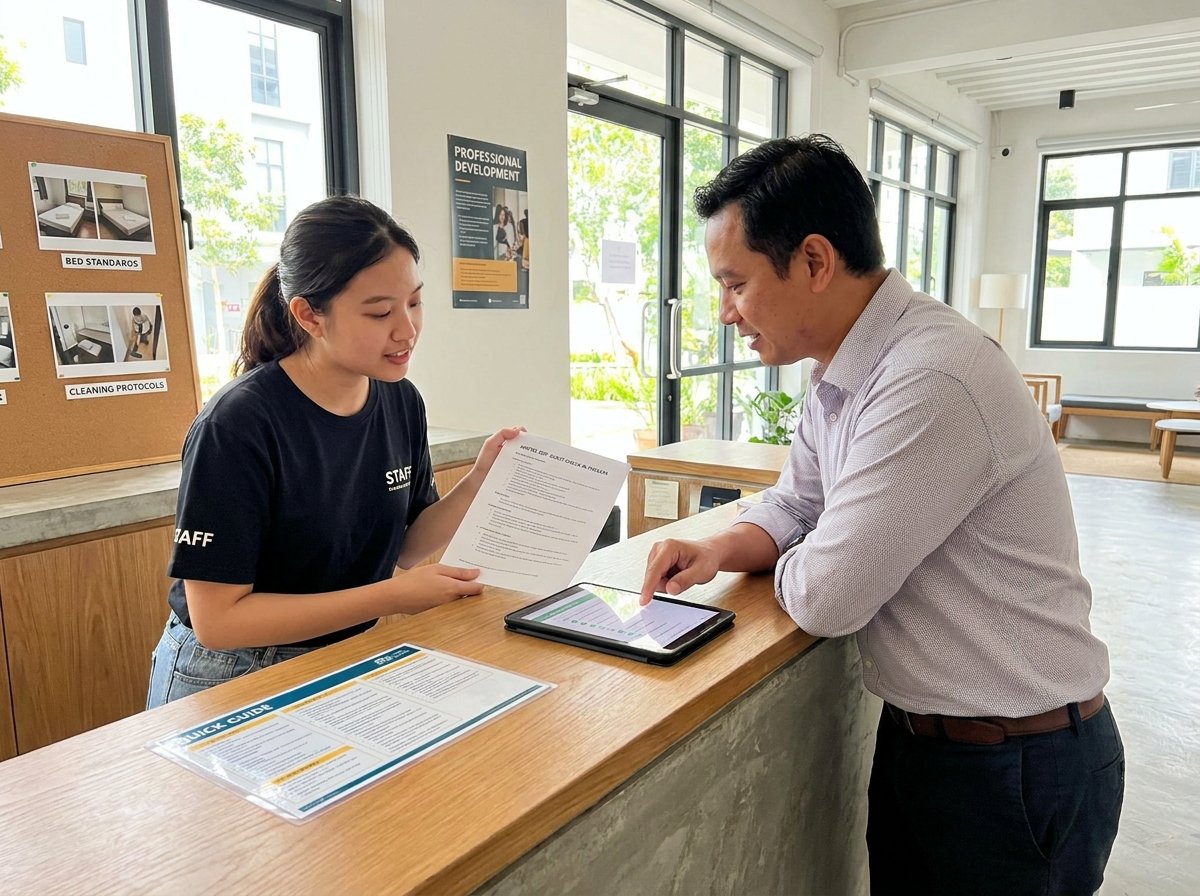
The difference between a hostel that runs at 65% occupancy and one that consistently hits 86% is rarely the location, the décor or the beds. It is the presence — or absence — of documented hostel standard operating procedures (SOPs). When a hostel has clear, trained, living SOPs, every staff member knows exactly what to do.
When it does not, every staff member improvises. And inconsistency, across check-in processes, housekeeping standards and guest communication, directly translates to lower review scores, weaker OTA ranking and occupancy that stagnates.
After 20 years operating hostels across eight European cities, we have seen this dynamic play out dozens of times. A hostel runs smoothly for the first six months because the owner is there every day. Then the owner steps back, hires staff, and suddenly the guest experience becomes fragmented.
Check-in looks different on each shift. Bed standards vary. Some staff request reviews; others don’t. Guest satisfaction drops. Booking.com algorithm notices and ranks the property lower. Occupancy falls. The owner’s immediate response is usually to lower prices or “improve the product.” The actual fix required is much simpler: documentation.
This guide walks through every standard operating procedure a hostel owner needs, why each one matters, and how to write SOPs that staff will actually follow.
Why hostel SOPs are different from hotel SOPs
Before diving into specific procedures, it is worth understanding why hostel standard operating procedures cannot simply be adapted from hotel operations — they are fundamentally different systems.
Hostels sell beds, not rooms
A 60-room hotel has one unit of inventory per room. A 60-bed hostel has six units of inventory per dorm. This distinction changes everything about pricing, assignment and revenue management.
When you have bed-level inventory, your SOPs must cover:
- Which bed is assigned to which guest (by window, by aisle, by guest preference, by system default)
- Whether guests can request specific beds after arrival
- How to handle uneven fills (5 of 6 beds booked — who gets the last bed, and at what price)
- Whether individual beds in a dorm can be sold at different rates to different guests
A hotel SOP for room assignment is 5 steps. A hostel SOP for bed assignment is 15 steps because the complexity is fundamentally higher.
In a hotel, the guest experience happens in the private room. The front desk, lobby and corridors are functional infrastructure. In a hostel, shared spaces — the lounge, kitchen, common dining area — are where 40–50% of the guest experience happens. This means hostel standard operating procedures must cover:
- Daily cleaning schedules for common areas (not just bedrooms)
- Programming and community activities (weekly house dinners, activities, social gatherings)
- Conflict management in shared spaces (noise complaints, locker disputes)
- How to foster atmosphere and belonging (staff interaction with guests in common areas)
A hotel housekeeping SOP does not include “organise a weekly community dinner.” A hostel housekeeping SOP must.
Staff is part of the guest experience, not invisible infrastructure
A hotel guest barely interacts with staff. A hostel guest interacts with staff constantly — at check-in, in common areas, during activities, at checkout. The personality, energy and attentiveness of staff directly shapes the guest’s perception of the hostel.
This means SOPs must balance two things: consistency (everyone follows the same process) and personality (everyone can bring their own warmth and style to it). An SOP that is too rigid (“You must say these exact words”) will either be ignored or will kill the social energy that makes a hostel a hostel.
Turnover is higher and team is smaller
An independent hostel typically has 5–10 staff. A hotel has 50–100. This means:
- When one person leaves, they take 10–20% of operational capacity with them
- You cannot afford weeks of training — new hires must be productive within 3–5 days
- Word-of-mouth culture spreads differently in a tiny team
- One person’s mistakes affect the whole property’s reputation
A hotel SOP can be 20 pages and handed to new hires as a “handbook.” A hostel SOP must be skimmable, learnable in one shift, and referenced during actual work. If it requires reading 5 pages before a new hire can check in their first guest, it has failed.
The domino effect: why a poorly documented SOP actually costs occupancy
Understanding why SOPs matter is the difference between creating them and actually maintaining them. So here is a concrete scenario.
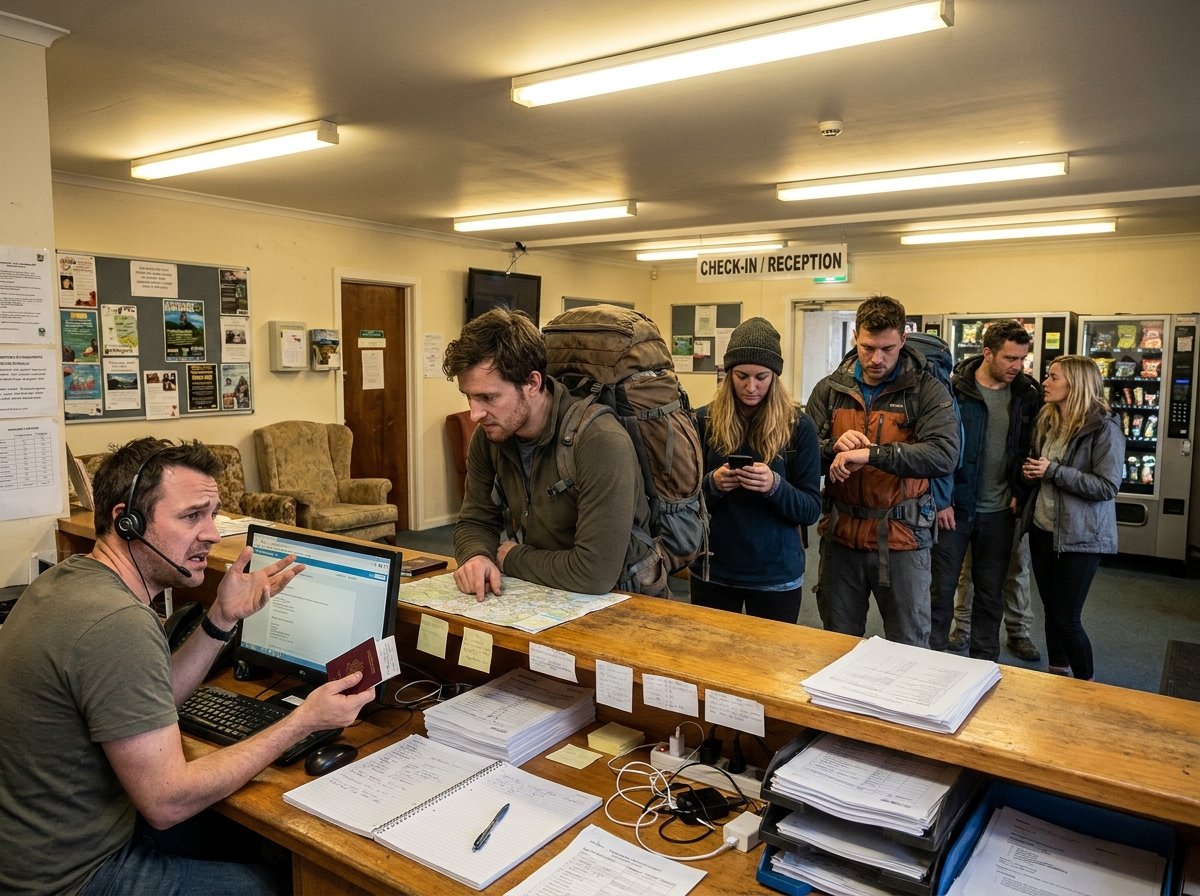
Hostel ABC: Barcelona, 60-bed property, no written check-in SOP.
Week 1–4: Maria, the receptionist who has been there two years, trains a new hire. The training is informal — “watch me do this for a few hours, then you try.” The new hire misses steps:
- Some guests get a pre-arrival email; some don’t (depends on whether Maria remembered).
- Some guests are asked their bed preference; some are assigned randomly.
- Some guests get a facilities tour; some get a key and a “your bed is upstairs.”
- Check-in time ranges from 5 minutes to 25 minutes depending on guest chattiness and Maria’s energy that day.
- Some staff mention the review request at checkout; others forget.
Week 5–8: Guests start leaving reviews. Inconsistency is visible in the text:
- Positive reviews: “Maria is so warm and helpful, gave us great tips on Barcelona.”
- Negative reviews: “Check-in was chaotic and took forever. Didn’t know which locker was mine. No one explained how anything works.”
Average property rating: drops from 8.7 to 8.3 in one month.
Week 9–12: Booking.com’s algorithm detects the rating drop. The property moves from position 3 to position 6 in Barcelona hostel search results. Daily visibility drops 40%.
Month 4–6: Occupancy declines from 78% to 62%. The owner sees falling occupancy and assumes the problem is price. They lower rates by 10%. Occupancy improves slightly (to 65%) but margins are now worse. Revenue has actually fallen.
What would have prevented this: A 20-minute check-in SOP written in week 1. Trained to Maria and the new hire in one hour. Followed consistently. Rating stays at 8.7. Booking.com ranking stable. Occupancy holds at 78%. No price cut needed.
The actual cost of not having a documented SOP: 60 beds × 13% occupancy drop × 365 days × €25 average rate = €71,000 in lost annual revenue. This is the price of inconsistency.
At Onefam, we have data across 19 properties:
| Property characteristic | Occupancy rate | Review score |
|---|---|---|
| Without documented SOPs | 65% | 7.2 |
| With SOPs, trained but not updated | 74% | 8.1 |
| With SOPs, documented and updated quarterly | 86% | 9.1 |
The difference between 65% and 86% occupancy on a 60-bed property is €119,000 per year. That is what documented hostel standard operating procedures are worth.
The core SOPs every hostel needs
Not every hostel task needs an SOP. The tasks that need documentation are the ones that:
- Happen frequently (daily or multiple times per shift)
- Directly impact guest experience or safety
- Have inconsistency costs (if done differently by different staff)
- Require training of new hires
Here are the six SOPs that every hostel should have, and why each one matters.
SOP 1: Guest Check-In Procedure
What it covers:
- Greeting and initial interaction (tone, energy, eye contact)
- Verification of guest ID and reservation (security and compliance)
- Payment processing (PMS entry, cash handling, card processing, refund policy awareness)
- Bed or room assignment (preference matching, group coordination, system entry)
- Facilities and policies explanation (WiFi password, kitchen rules, quiet hours, emergency exits, locker assignment)
- Upselling protocol (private room upgrade offer, activity booking, merchandise) — optional but documented so it is consistent
- Review request timing and delivery method
Why it matters:
Check-in is the first physical interaction between the hostel and the guest. It sets the tone for the entire stay. Inconsistent check-ins create inconsistent first impressions:
- Guest A: warm welcome, clear explanation, 10 minutes, feels cared for
- Guest B: rushed check-in, unclear explanations, 20 minutes, feels like a transaction
Both guests stay in the same property but have entirely different first impressions. Guest A leaves a positive review mentioning staff warmth. Guest B mentions slow and disorganised check-in.
Additionally, undocumented check-in processes lead to:
- Missing security steps (ID not verified = liability issue if incident occurs)
- Inconsistent upselling (some guests offered private room upgrade, others not = perception of unfairness)
- Missed review requests (if it is not in the SOP, staff forget — and missing review requests = fewer reviews = lower average score)
A hostel with a documented, trained check-in SOP sees:
- Average check-in time: 10–12 minutes (consistent across all staff)
- Review score impact: +0.5–1.0 point on average rating
- Occupancy impact: consistent first impression = more positive reviews = higher OTA ranking
SOP 2: Housekeeping and room cleaning standards
What it covers:
- Daily morning turnover process (time allowed, exact sequence: empty room → clean floors → wipe surfaces → remake beds → inspect → status change in PMS)
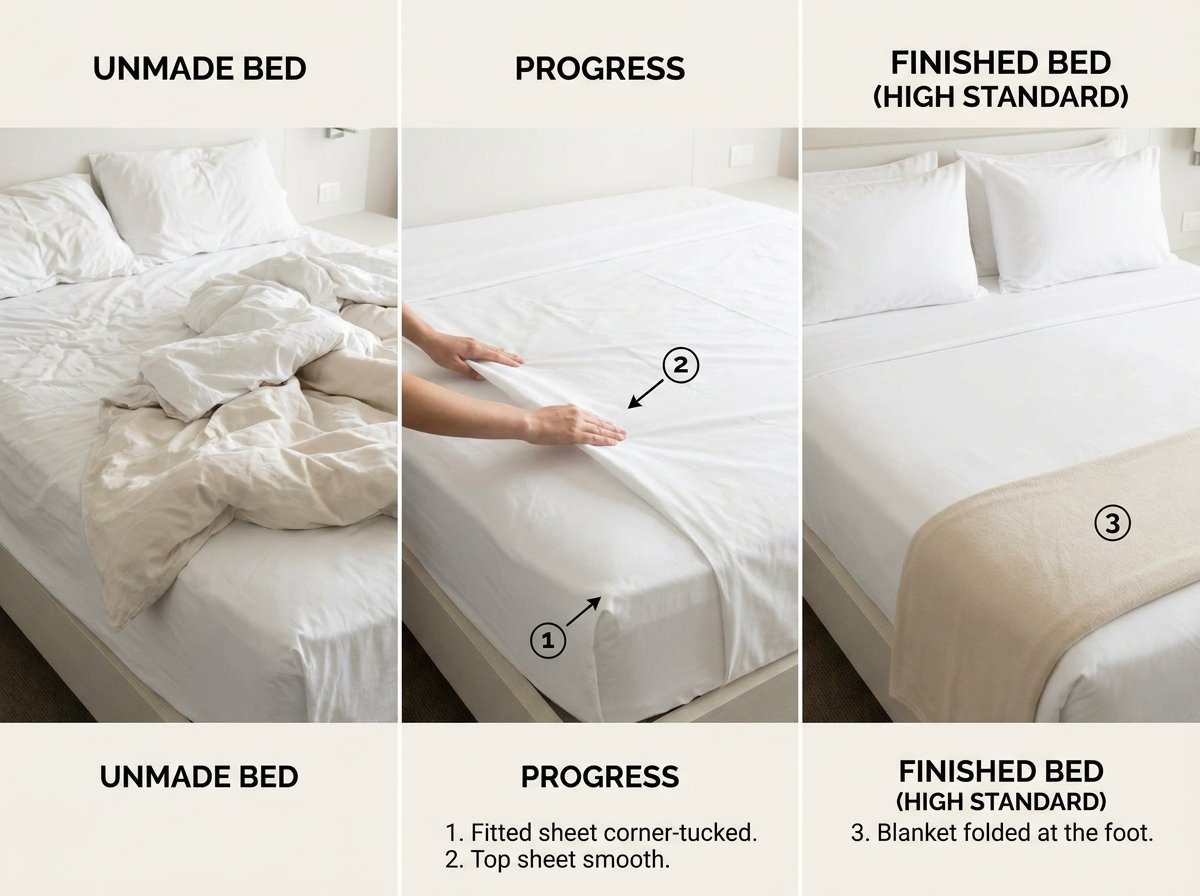
- Bed-making standard (including reference photos: how to fold sheets, pillow placement, blanket arrangement)
- Common area cleaning schedule (specific times, responsible staff member, checklist per area)
- Maintenance log workflow (how issues are reported, who resolves them, target resolution times, follow-up)
- Laundry protocols (towel rotation frequency, linen quality checks, stain removal procedures)
- Inspection checklist (what constitutes “ready for guest,” what requires rework)
Why it matters:
Cleanliness is the single attribute most directly correlated with hostel review scores. A 2024 analysis across OTA platforms showed that “cleanliness” is mentioned in 60% of reviews for properties with ratings below 8.0, and only 15% of reviews for properties with ratings above 9.0. The reason is simple: guests notice and comment on cleanliness when it is inconsistent or poor; they take it for granted when it is consistently high.
Without a documented housekeeping SOP:
- Different staff clean to different standards (some make beds tightly, some leave them loose; some do deep cleaning, others surface-level)
- Maintenance issues are reported informally (“Maria, the toilet in dorm 3 is broken”) and often forgotten
- New hires take 2–3 weeks to reach quality standard because they are learning by observation
- Turnover in one room takes 45–90 minutes (sometimes longer if person is slow)
With a documented SOP:
- All staff clean to the same standard (reference photos eliminate ambiguity)
- Maintenance issues are logged, assigned, tracked and resolved on schedule
- New hires reach standard within 2–3 days because steps are explicit
- Turnover in one room takes 25–35 minutes consistently
- Review score correlates directly: properties with strong housekeeping SOPs average 9.1 rating; those without average 7.8
SOP 3: Staff complaint resolution
What it covers:
- Initial complaint intake (listen, write it down, don’t dismiss, get specific details about what happened and what guest wants)
- Empowerment levels (what staff can approve without manager: late checkout, room move, towel/locker replacement, WiFi restart; what requires manager approval: refund, booking cancellation, compensation)
- Escalation path (when to call manager during shift, when to escalate to owner, what constitutes a security or legal issue)
- Documentation of every complaint (logged in spreadsheet or PMS notes to identify patterns)
- Follow-up protocol (staff follow up with guest 24 hours after complaint resolution, offer small gesture if appropriate)
Why it matters:
A guest complaint handled well in the moment rarely becomes a negative review. A complaint ignored almost always does.
More importantly, undocumented complaint handling leads to:
- Inconsistent responses (some complaints get fast resolution, others get ignored depending on staff mood)
- Long resolution times (staff doesn’t know if they can approve a room move, so they wait for manager, guest waits 30 minutes for a 2-minute fix)
- No pattern identification (if 10 guests complain about WiFi being slow, without documentation you don’t see the pattern and fix it)
- Liability exposure (staff handle complaints poorly, guest escalates to platform or regulator)
With a documented complaint SOP:
- Staff know immediately what they can handle (empowerment) and what needs escalation
- Response times drop (staff handle minor issues instantly)
- Patterns emerge (you see that WiFi is a repeat issue and prioritise fixing it)
- Guest satisfaction improves (handled complaints don’t become reviews)
A property that actively resolves complaints vs. one that ignores them can see a 1–2 point difference in average rating.
SOP 4: Review request and management
What it covers:
- When to request reviews (at checkout, ideally in the last 24 hours of stay, not during arrival when guests are stressed)
- How to request (verbal + email, with direct links to Hostelworld and Booking.com, optional note: “We’d love to know what you thought”)
- Tone (friendly, never pushy — “If you enjoyed your stay, we’d appreciate a quick review” not “You must leave a review”)
- Response to negative reviews (every negative review gets a response within 24–48 hours, tone is professional and solution-focused)
- Escalation of specific negative review categories (review mentions cleanliness issue → housekeeping manager investigates; review mentions staff rudeness → manager follows up with staff member)
Why it matters:
Hostels that actively request reviews receive 40–60% more reviews than hostels that don’t request reviews. More reviews statistically correlate with a higher average score — this is a platform effect. When a property has 50 reviews, one negative review drops average by 0.2 points. When a property has 500 reviews, one negative review has negligible impact. More reviews = less volatility = higher average.
Additionally, responding to negative reviews within 24–48 hours signals to future guests:
- “This hostel listens and acts on feedback”
- “Even if something goes wrong, they will try to make it right”
Properties with documented review request and response SOPs see:
- Review volume +40–60% vs. properties without SOP
- Average score +0.3–0.7 points higher (due to volume effect and response strategy)
- OTA ranking improved (platforms weight both score and review volume in ranking)
SOP 5: Programming and community activities
What it covers:
- Minimum weekly programming (at least one house dinner, one activity, one social gathering — documented in advance)
- Activity planning timeline (scheduled and announced 2–4 weeks in advance, not day-of)
- Booking and attendance tracking (via PMS notes or simple spreadsheet)
- Staff role assignment (who facilitates, who sets up, who cleans up, who manages budget)
- Budget allocation (weekly programming budget, e.g., “€50–100 per week for food, supplies, activities”)
- Guest communication (how activities are promoted — posted in common areas, email to all guests, posted in messaging during pre-arrival)
Why it matters:
Programming is the lever that transforms a building with beds into a community. A hostel without programming is a place to sleep. A hostel with consistent programming is a place to meet people and have experiences.
Data from our 19 properties shows:
- Hostels with weak programming (0–1 activity per week): average ALOS (average length of stay) 1.8 nights, repeat guest rate 4%
- Hostels with strong programming (3+ activities per week): average ALOS 2.6 nights, repeat guest rate 16%
For a 60-bed hostel, the difference in ALOS alone is significant:
- 1.8 nights ALOS: 60 beds × 360 available days ÷ 1.8 = 12,000 guest-nights per year
- 2.6 nights ALOS: 60 beds × 360 available days ÷ 2.6 = 8,308 guest-nights per year
Wait — that math is backwards. Let me recalculate: ALOS is how many nights each guest stays. If ALOS is longer, that means fewer guest turnovers but the same total nights sold.
The real impact: guests who stay longer leave better reviews (they have more time to enjoy the hostel), they are more likely to return, and they refer more friends. A hostel with strong programming sees 0.5–1.0 point higher rating because guests have more reasons to stay and more experiences to appreciate.
Without a documented programming SOP:
- Activities happen randomly (depends on staff energy and initiative that day)
- Guests don’t know what to expect
- Programming dies if one enthusiastic staff member leaves
- Budget is unclear (is there money for activities or not?)
With a documented SOP:
- Programming is predictable (guests know there is dinner every Thursday)
- Staff knows their role (no guessing about setup, budget, or cleanup)
- Budget is set (everyone knows they have €100 to work with this week)
- Continuity survives staff turnover (program lives in the SOP, not in one person’s head)

SOP 6: Opening and closing procedures
What it covers:
- Opening shift (arrival time, unlock procedure, overnight issue scan, system reset, PMS alert review, key count, petty cash count)
- Closing shift (final guest count, PMS reconciliation, cash count and deposit recording, door/window lock check, unnecessary lights off, equipment shutdown, incident log for next shift)
- Shift hand-off communication (what closing shift tells opening shift, what opening tells day shift, critical alerts or guest flags)
Why it matters:
Opening and closing procedures are the backbone of operational control. Without documented procedures:
- Security is inconsistent (pdoors might be left unlocked, cash is not counted)
- Financial integrity is compromised (cash discrepancies occur, no one knows why)
- Incidents are missed (a guest reported an issue to night staff, morning staff doesn’t know)
- Systems are not reconciled (PMS shows different numbers than physical room status)
With a documented SOP:
- Every shift starts with a clean handoff (opening staff knows what night staff handled)
- Cash is counted consistently (discrepancies are flagged immediately)
- Security is assured (doors are locked, systems are armed)
- Guest issues don’t fall through cracks (incidents are logged and communicated)
How to write a hostel SOP that staff will actually use
A documented SOP that no one follows is worse than no SOP — it signals that documentation is pointless. Here is how to write SOPs that work.
Step 1: Observe and involve your staff
Do not write SOPs alone at your desk. Spend a full shift observing how your best front desk person does check-in. Note every step, every deviation, every moment of confusion or improvisation.
Ask your staff directly: “What is the most frustrating part of check-in?” “When do new hires make mistakes?” “What works really well?” “What would make this process faster?”
Your staff knows more than you. Usually the problem is not that they are doing things wrong — it is that they are doing the same thing four different ways without realizing it.
Step 2: Define the purpose
Every SOP starts with a clear purpose statement. This is not bureaucracy — this is clarity.
Bad purpose: “The purpose is to check in guests.” Good purpose: “The purpose is to check in guests in under 12 minutes, make them feel genuinely welcome, collect all required information, and present the hostel’s facilities and community clearly so guests feel confident and positive about their stay.”
The good purpose tells staff why they are doing this, not just what they are doing.
Step 3: Write like a recipe, not a rulebook
SOPs that sound like punishment are ignored. SOPs that sound like best practices are followed.
Bad: “Staff MUST greet guest within 30 seconds of arrival. Failure to do so will result in verbal warning.” Good: “Greeting (first 30 seconds): Make eye contact, smile genuinely, and say something like ‘Hey, welcome to [Hostel Name]! How was your journey?’ This sets the tone. Guests who feel warmly welcomed from the first moment leave better reviews.”
Notice the difference: the good version explains the human impact, not the punishment.
Step 4: Include the why, not just the what
Every SOP needs a “Why this matters” section. This is what separates SOPs that are followed from SOPs that are filed away.
Example: “SOP: Request review at checkout Why this matters: Guests who leave reviews (even critical ones) are more likely to book again and refer friends. Hostels that actively request reviews receive 40–60% more reviews per month. More reviews = higher average score on booking platforms = better ranking = more bookings. Your effort asking for a review directly impacts occupancy next month.”
When staff understand the business impact, they do the work.
Step 5: Make it skimmable
Format matters. SOPs should be:
- One page per procedure (or one page + one reference page maximum)
- Clear headings and numbered steps
- Simple language (no jargon)
- Visual elements where helpful (photos of standards, checklists, diagrams)
Recommended SOP structure:
[Title]
Purpose: [one sentence explaining the goal and who it is for]
Scope: [when this SOP applies]

Steps:
1. [First step, clear and actionable]
2. [Next step]
3. [Next step]
...

Checklist (if applicable):
☐ Item 1
☐ Item 2

When to escalate:
[Situations that exceed this SOP]

Photos of standard (if applicable):
[Photo of correctly made bed, clean room, etc.]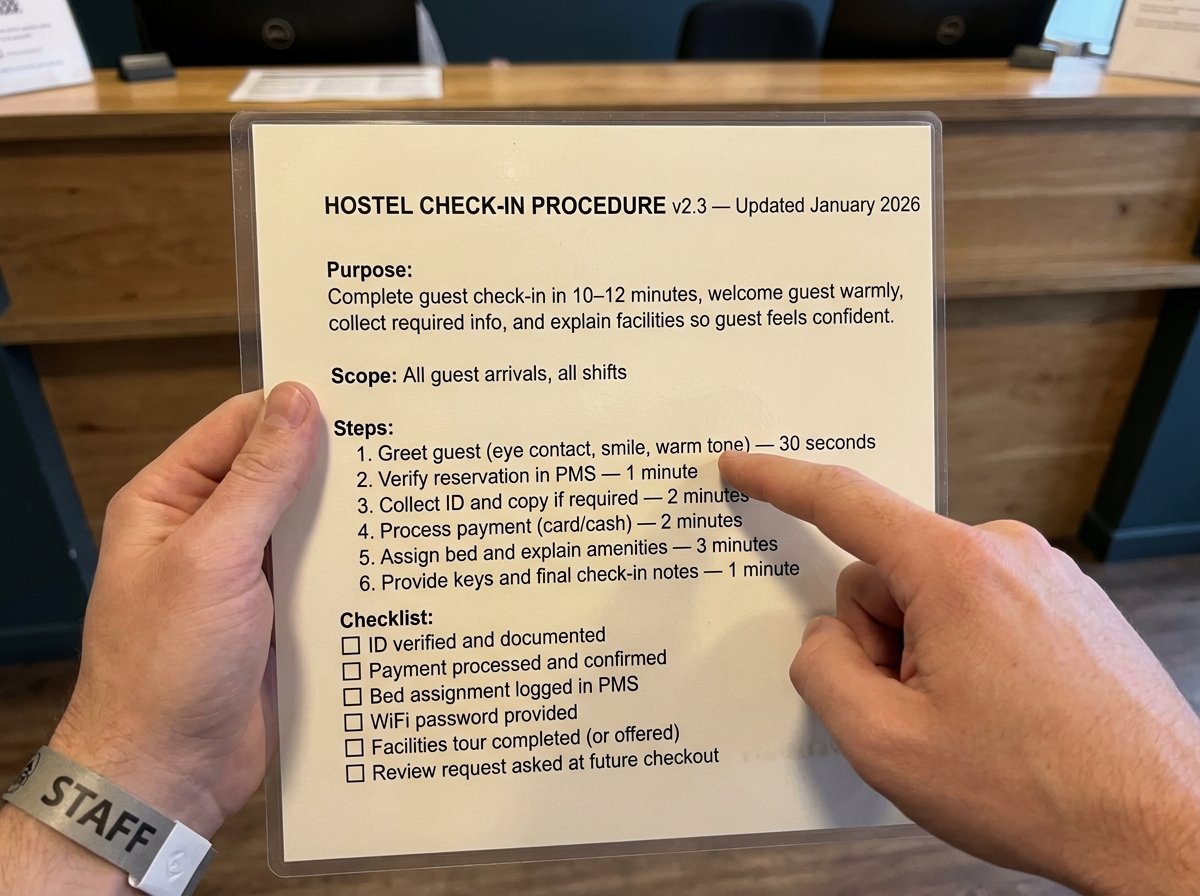
Step 6: Version and date your SOPs
“Hostel Check-In Procedure v2.3 — Updated January 2026”
Versioning signals that SOPs are living documents, not fixed rules. Staff respects versioned docs more than outdated ones.
Step 7: Train and test before rollout
Do not email an SOP and expect it to be used. Train someone. Observe them executing it. Adjust if needed.
If a new hire cannot execute the SOP confidently after one training session, the SOP is too complicated. Simplify it.
Common SOP mistakes that kill adoption
Mistake 1: Writing SOPs too long
A 20-page document will not be used. A 5-page document will be skimmed and then ignored. SOPs should be maximum one page per procedure. If more detail is needed, use a separate reference sheet.
Mistake 2: Involving too many stakeholders in creation
If you ask five people to write the check-in SOP, you get five different versions and none will be used. One person writes (ideally your best performer in that role). One person reviews briefly. Then it is done.
Mistake 3: Setting unrealistic standards
“Check-in must be completed in 5 minutes for all guests including payment processing, questions and room assignment.”
That is not a standard; that is fantasy. Realistic: “Check-in standard is 10–15 minutes depending on guest questions and group size. Complex situations (room changes, refunds, reservations issues) may exceed standard and should be logged.”
Mistake 4: Writing for perfection, not practice
“The front desk staff should greet the guest with a genuine smile and ask about their journey in a warm and welcoming tone.”
Vague. Better: “Greeting: Say ‘Hey, welcome to [Hostel Name]! How was your journey?’ Smile. Make eye contact.”
Mistake 5: Not linking SOPs to outcomes
Staff does not care that the SOP exists. They care: does this help me do my job better? Will I be evaluated on this? Will it make my shift easier?
Every SOP should link to a metric.
“Check-in SOP impacts:
- Average check-in time (goal: <12 minutes)
- Guest review score (goal: 9.0+ rating)
- Staff confidence with new guests (goal: new hire competent within 3 days)”
Mistake 6: Never reviewing or updating
SOPs written in 2022 that still reference an old PMS in 2025 are worse than no SOP. Review every six months minimum. Update when:
- A new tool or system is implemented
- Staff feedback indicates a step is unclear
- You notice the SOP is not being followed
Digital tools vs. printed manuals for SOPs
Where do you keep SOPs so staff actually uses them?
Printed manual: Physical copy, accessible without internet, but versioning is nightmare and updates are slow.
Google Drive: Easy to update, version control built-in, accessible from phone. Staff has to remember to look. Simple folder structure helps.
Notion, Asana, or dedicated SOP platform: Searchable, can link procedures together, can assign and track who has read what. Costs money, requires training.
Recommendation for independent hostels: Google Drive with clear folder structure + laminated checklists in each operational area (e.g., laminated check-in checklist behind reception desk, laminated bed-making checklist in housekeeping area).
Front desk SOP lives in Google Drive for detailed reference. A simplified checklist version is printed and laminated for daily use.
Measuring if your SOPs are actually working
Documented SOPs do not automatically mean followed SOPs. How do you know staff is actually using them?
Metric 1: Check-in time consistency Baseline without SOP: 12–20 minutes, high variability With trained SOP: 10–12 minutes, low variability
Measure: Time from guest arrival to keys in hand. Track for one week. If range is 10–12 minutes across all shifts, SOP is working.
Metric 2: Review score consistency Without SOP: ratings fluctuate 7.2–9.1 depending on which staff worked With SOP: ratings cluster 8.8–9.2
If your average rating trends upward and variance shrinks after SOP rollout, SOP is working.
Metric 3: Complaint frequency Without SOP: random complaints, no pattern With SOP: fewer complaints overall, and patterns are clear (e.g., WiFi complaints rather than “staff didn’t explain how anything works”)
Metric 4: Training time for new hires Without SOP: 2–3 weeks for new hire to be competent independently With SOP: 3–5 days
If new hires reach independence faster, SOP is working.
If after one month of rollout these metrics do not improve, your SOP has a problem: it is too complex, unrealistic, or not trained properly. Adjust and retest.
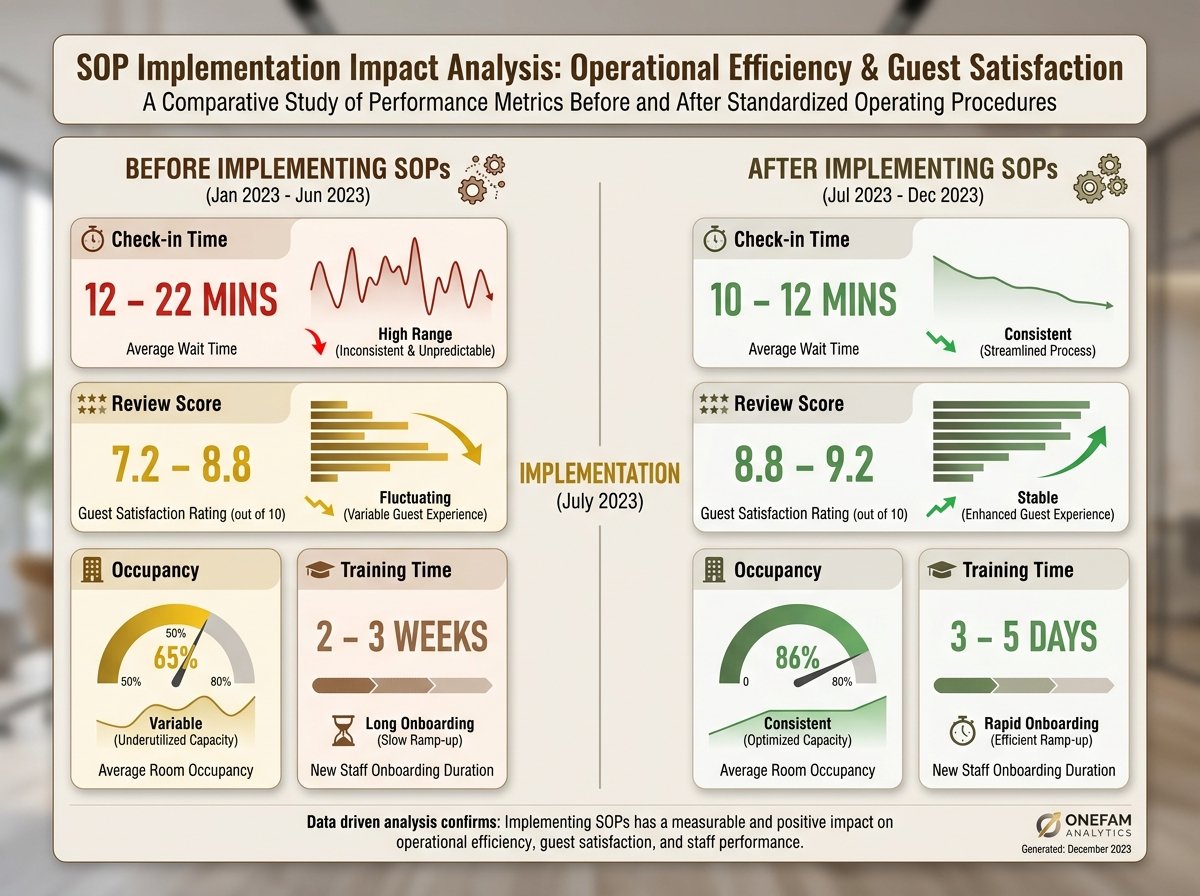
Why managed hostels have higher occupancy: the role of documented SOPs
This is the inflection point in many hostel businesses. A solo operator or small team can run one hostel reasonably well through force of will and constant presence. But at two, three, or four properties, the owner cannot be everywhere. Quality becomes inconsistent. Occupancy drops. The owner concludes they need to hire more people.
Actually, they need documented systems.
Hostels without documented hostel standard operating procedures:
- Occupancy fluctuates 60–75% (unpredictable, dependent on staff mood and owner presence)
- Reviews vary widely 7.2–8.8 (depends which staff worked)
- Staff turnover is high 40–60% annually (burnout from lack of clarity)
- Owner is constantly in operations (cannot step back to think strategy)
- Pricing is reactive, not proactive (owner responds to occupancy drops instead of forecasting demand)
- Cannot scale beyond one property (each property requires owner presence)
Hostels with documented, trained SOPs:
- Occupancy is consistent 84–88% (system-driven, not staff-driven)
- Reviews trend upward 8.9–9.2 (consistent execution across shifts)
- Staff retention improves 20–25% annual turnover (people want to work somewhere with clear expectations)
- Owner can step back and focus on strategy (operations run without constant oversight)
- Revenue management is possible (stable operations allow pricing strategy)
- Can scale to multiple properties (SOPs allow replication of proven systems)
At Onefam, our ability to operate 19 properties across eight cities without the founder being present every day is entirely dependent on SOPs. Every hostel operates to the same standard. Every guest checks in consistently. Every room is cleaned to standard. Every complaint is logged and resolved.
For an independent operator with one or two hostels, documenting SOPs is the single highest-ROI investment of time you can make in the first year. It is the foundation for everything else — revenue management, guest experience, staff retention, and eventual scaling.
Conclusion
Hostel standard operating procedures are not administration — they are the system that allows your hostel to function without you being there every moment. The difference between a hostel that grows profitably and one that stagnates is usually not the product. It is the systems.
If you are operating one hostel and thinking about opening a second, or operating multiple properties and thinking about scaling further, documenting your hostel standard operating procedures now is the highest-leverage use of your time.
The process is straightforward: observe your best staff, write down what they do, test the SOP, refine it based on feedback, train everyone, and then maintain it through quarterly reviews. A documented SOP takes four to six weeks to write properly. It saves thousands in lost revenue and countless hours in staff confusion.
If you are at the point where you need to scale without sacrificing quality — where you want 86% occupancy and 9.1 review scores consistently across multiple properties — understanding how a professional hostel management company structures operations through SOPs, training, and continuous improvement can provide a roadmap for your own system.
Frequently asked questions
What are standard operating procedures (SOPs) in a hostel?
Standard operating procedures are documented, step-by-step instructions for recurring operational tasks. In a hostel, SOPs typically cover check-in, housekeeping, complaint resolution, review management, and staff training. SOPs ensure that every staff member performs tasks the same way, to the same standard, regardless of shift or personal preference.
Why are SOPs important for hostels?
SOPs drive consistency. Consistent operations lead to consistent guest experiences, which lead to consistent review scores. Consistent review scores drive better OTA ranking. Better ranking drives more bookings. Additionally, documented SOPs allow you to train new staff faster, scale to multiple properties, and step back from day-to-day operations. Without SOPs, quality depends on which staff member is working, and occupancy becomes unpredictable.
What SOPs should every hostel have?
Every hostel should have SOPs for: guest check-in procedure, housekeeping and room cleaning standards, staff complaint resolution, review request and management, programming and community activities, and opening and closing procedures. These six SOPs cover the highest-impact areas of guest experience and operational integrity.
How do you write an effective hostel SOP?
Start by observing your best staff member doing the task. Write down every step, including the non-obvious ones. Define a clear purpose (not just “what” but “why”). Use simple, skimmable language. Include a “why this matters” section. Format it as a one-page checklist with reference materials if needed. Test it with a new hire. Adjust based on feedback. Version and date it. Then train everyone and maintain through quarterly reviews.
How do you know if your hostel SOPs are working?
Track metrics: check-in time consistency (lower variability after SOP rollout), review score consistency (scores cluster rather than fluctuate), complaint reduction (fewer complaints overall), and training speed (new hires reach independence faster). If these metrics improve after one month, your SOP is working. If not, the SOP is likely too complex or unrealistic.
Onefam Hostels manages 19 properties across eight European cities with an average occupancy rate of 86% and a guest satisfaction score of 9.1. Every property operates with documented, trained, regularly updated standard operating procedures. If you are exploring how professional hostel management services use SOPs and systematic operations to drive consistent performance across multiple properties, contact us at partnership@onefamhostels.com.