
What Is hospitality investment? (And where Hostels fit)
Hospitality investment is the deployment of capital into accommodation and lodging assets—including hotels, resorts, serviced apartments, and hostels—to generate income through operations, appreciation, or both. Within this broad sector, hostel investment represents one of the most accessible, highest-yielding, and fastest-growing niches: a $6.14 billion global market in 2026 expanding at 11.6% annually, driven by Gen Z travel demand, the experiential economy, and the rise of digital nomadism.

When most investors think of hospitality investment, they picture full-service hotels, luxury resorts, or REITs. These are valid options. But they require significant capital, come with intense institutional competition, and often offer lower operational upside for a hands-on investor. Hostels occupy an entirely different niche—one where approachable entry prices, hotel-like margins, and a structurally growing demand base create an asymmetric opportunity.
The mechanics differ from hotels in one fundamental way: hostels generate revenue per bed, not per room. A 100-bed hostel in a European capital can produce more revenue per square metre than a 40-room select-service hotel in the same location—at a fraction of the acquisition cost. That is the core investment thesis.

The Hostel market in 2026: Size, growth and opportunity
The global hostel market is at an inflection point. After a COVID-era reset, the sector has rebounded with structural tailwinds that did not exist before the pandemic: a Gen Z travel cohort that is larger, more adventurous, and more digitally native than any generation before it; a digital nomad class that demands affordable, community-driven, long-stay options; and a premiumisation trend turning budget hostels into design-led lifestyle brands.
Global Hostel Market — Key Numbers 2026
$6.14B
Global market size 2026
11.6%
CAGR 2025–2026
$15.5B
Projected 2036
36%
Europe market share
Sources: Future Market Insights, Business Research Company, Grand View Research (2026)
What is driving Hostel demand in 2026?

- Gen Z and millennial travel surge — 86% of millennials travel to engage with experiences, not possessions (Bloomberg). 62% of global budget travellers now actively choose hostels over budget hotels. This demographic is growing as a share of total travel spend.
- Digital nomadism — The post-pandemic normalisation of remote work has created a massive demand base for affordable long-stay, co-working-enabled accommodation. Many hostels have adapted with dedicated workspaces and monthly rates, dramatically improving revenue stability.
- Solo travel growth — Solo travel, now one of the fastest-growing travel segments globally, is almost synonymous with hostel accommodation. Solo travellers are ideal guests: they pay full bed rates, spend on ancillaries, and generate the best reviews when social programmes are strong.
- OTA visibility and review dynamics — With 52.7% of hostel bookings now through online travel agencies (Hostelworld, Booking.com) and 55% via mobile, well-positioned hostels with strong review scores enjoy lower acquisition costs than most other accommodation types.
- Boutique hostel premiumisation — The emergence of “poshtels” (design-led premium hostels) and hybrid hostel-hotel concepts is expanding the addressable market beyond backpackers to include design-conscious travellers, young professionals, and workcation seekers.
Pros and cons of Hostel Investment
Like any investment, hostels carry a distinctive risk-reward profile. Understanding both sides in detail is the starting point for any serious investor.

✓ Pros
Higher revenue density
Revenue is generated per bed, not per room. A 100-bed dormitory in 200 m² out-earns a 25-room hotel in the same footprint.
Lower entry capital
Minimum viable entry from €300K–€500K for a renovation-ready property. Turnkey assets from €1M–€1.5M. A fraction of a comparable hotel.
Strong and growing demand
11.6% CAGR in 2026. Gen Z, digital nomads, and solo travellers are structurally underpenetrated by traditional hotel inventory.
High yields and IRRs
Annual yields of 6–8%. Equity IRRs of 12–22% on well-run assets. Exceptional operators report $800K NOI on an $821K purchase price.
Multiple ancillary revenue streams
F&B with 60–65% margins, events, tours, co-working, lockers, and merchandise add 15–30% to total revenue with negligible incremental CapEx.
Limited institutional competition
Institutional capital largely ignores hostels as “too small” or “too operational.” This keeps valuations rational and deal flow accessible to individual investors.
Brand and community moat
A hostel with a strong social identity, events programme, and 9.0+ review score builds a self-reinforcing community that produces lower OTA dependency and repeat bookings.
✕ Cons — and how to overcome them
High operational intensity (for independent operators)
Managing beds, bathrooms, staff turnover, OTA distribution, and guest programming simultaneously is genuinely demanding for solo operators. The solution: Onefam’s team of 150+ hospitality professionals takes over every aspect of daily operations — from staff recruitment to daily oversight — leaving owners with transparent reporting and zero operational burden.
Review-driven reputation risk (neutralised by brand and systems)
A single viral bad review can devastate occupancy for weeks. This risk is real — but it is a product of poor management, not of the asset class itself. The solution: All 18 Onefam properties consistently score above 9.0 on Hostelworld and Booking.com, the result of systematic guest experience programming and 20 years of operational refinement. Your asset inherits that standard from day one.
Seasonal volatility (largely eliminated at chain scale)
Standalone hostels in single markets can see occupancy swings of 30–50 points between peak and low season. The solution: Onefam maintains 86% average annual occupancy — not in summer alone, but year-round — because demand is spread across 8 European cities with different seasonality profiles, supported by active revenue management that continuously captures off-peak demand.
Location dependency
Hostels outside proven tourist corridors or city centres almost never achieve viable occupancy, regardless of how well they are managed. Location selection is the most critical decision in any hostel investment and must be validated before any capital is committed. Onefam’s expansion strategy — Barcelona, Madrid, London, Amsterdam, Prague, Budapest, Porto, Seville, Rome and Florence — is itself a location filter backed by years of operational data.
Regulatory and zoning risk
Short-stay accommodation regulations are tightening across European and North American cities. Zoning restrictions, tourist tax increases, and licensing requirements vary by municipality and are subject to change. This is a genuine structural risk that must be assessed at the asset level — and a reason to work with operators who already manage compliance across multiple jurisdictions simultaneously.
The bottom line on cons
The three most cited barriers to hostel investment — operational complexity, reputation risk, and seasonal volatility — are not inherent to the asset class. They are inherent to operating a hostel without professional infrastructure. Every one of them is resolved by investing through or handing management to an experienced operator. The two risks that remain — location and regulation — exist in every real estate class. They are manageable with the right due diligence and the right partner.
Types of Hostels: Which model performs best?
Not all hostels are created equal. The investment profile—and the right strategy—differs significantly across hostel types. The global market is segmented into four main categories, with boutique and hybrid models emerging as the highest-growth and highest-margin sub-segments.
| Type | Market Share | CAGR | Target Guest | Investor Profile |
|---|---|---|---|---|
| Youth / Backpacker | 38.2% | ~7% | Backpackers, gap-year | Established markets, high volume |
| Student Hostel | 22.4% | ~8% | International students | University cities, stable demand |
| Traditional Hostel | 21.1% | ~6% | Budget travellers | Value-add repositioning opportunity |
| Boutique / Poshtel ⭐ | 18.3% | ~9.8% fastest | Digital nomads, design travellers | Highest margin, premium ADR |
The rise of the “Poshtel” and Hybrid Hostel Model
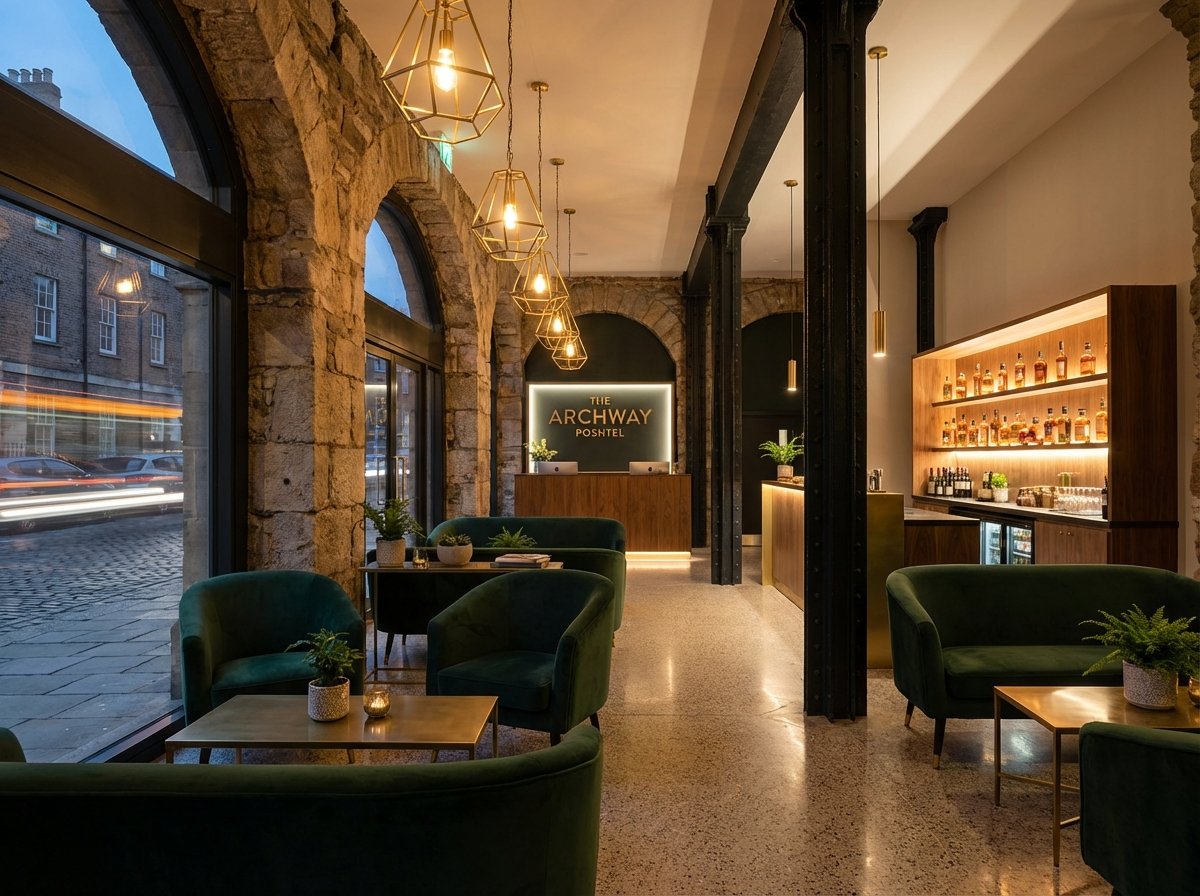
The most compelling investment opportunity in the hostel sector is the boutique or “poshtel” model—born from a convergence of “posh” and “hostel.” These properties combine dormitory beds (for pricing power and community density) with private rooms, premium design, co-working spaces, and curated food and beverage. Landmark examples include U Hostel in Madrid (located in a 19th-century palace), Generator Hostels across European capitals, and Kex in Iceland (in a former cookie factory).
The hybrid model—mixing dormitory and private rooms in a 60/40 or 70/30 split—consistently achieves the best revenue per available bed (RevPAB). Private rooms allow ADR flexibility and attract guests who want the social atmosphere of a hostel without dormitory sleeping. This unlocks a broader addressable market and higher average spend per guest.
Key metrics for Hostel Investors
Hostel performance is measured differently from hotels. The table below defines the seven metrics that matter most when underwriting a hostel investment.

| Metric | Definition | Benchmark 2026 |
|---|---|---|
| RevPAB | Revenue Per Available Bed. ADR per bed × Bed Occupancy Rate. | €10–€45/bed/night depending on market and type |
| Bed Occupancy | Beds sold ÷ total beds available × 100. Primary performance indicator. | Target: 70–85%. Breakeven: ~65% |
| ADR/bed | Average Daily Rate per bed sold. Ranges widely by type and market. | Dorm: €15–€45 | Private room: €60–€150/night |
| NOI Margin | Net Operating Income ÷ Total Revenue. Target range for well-run hostels. | 25–45% of total revenue (vs. 20–35% for hotels) |
| Ancillary % | Non-bed revenue as % of total (F&B, events, co-working, lockers). | Target: 15–30% | F&B margin: 60–65% |
| Review Score | Average score on Hostelworld and Booking.com. Direct correlation to occupancy. | Minimum viable: 8.0/10 | Target: 9.0+ |
| Payback Period | Years to recoup initial investment from NOI. Key investor metric. | Well-managed assets: 7–12 years |
How to evaluate a Hostel investment opportunity
Follow this 8-step checklist when evaluating any hostel asset or investment opportunity.

- Validate the location — Assess proximity to transport hubs, tourist attractions, and university districts. Confirm zoning permits short-stay accommodation and check for any noise or residential complaints history. Location failure accounts for the majority of hostel underperformance.
- Analyse bed capacity and revenue density — Count total beds and calculate maximum Revenue Per Available Bed (RevPAB). Compare to the local competitive set. Higher bed counts per square metre directly improve revenue potential.
- Review occupancy and ADR history — Request 3 years of occupancy data, average daily rate per bed, and seasonal patterns. Normalise for COVID-era anomalies. Prioritise properties with sustained bed occupancy above 70%.
- Assess ancillary revenue streams — Evaluate F&B revenue (target 15–25% of total), events, tours, co-working, and locker income. Ancillary revenue with 60–65% margins can transform a marginal operation into a highly profitable one.
- Audit online reputation — Analyse Hostelworld, Booking.com, and Google reviews in depth. A score below 8.0/10 on Hostelworld is a red flag. Volume and recency of reviews matter as much as the average score.
- Evaluate physical condition and CapEx needs — Commission a property condition assessment. Dorm furniture, bathrooms, common areas, and kitchen equipment have intensive replacement cycles. Budget 5–8% of revenue annually for maintenance and refresh.
- Review licensing and compliance — Confirm all short-stay permits, fire safety certificates, alcohol licences, and local authority registrations are current and transferable. Non-compliance is the most common deal-breaker in hostel acquisitions.
- Model exit scenarios — Hostels are less liquid than hotels. Plan a 5–10 year hold. Model base, upside, and downside exits. Consider sale to an operator, hotel conversion, or repositioning as a boutique co-living property.
The smarter path: Investing through a professional Hostel Operator
Every step of the due diligence checklist above demands expertise, local market knowledge, and operational infrastructure that most first-time hostel investors simply do not have. The location must be right. The licensing must be clean. The revenue management must be active and dynamic. The guest experience must be good enough to sustain a 9.0+ review score. Get any one of these wrong, and the investment underperforms — or fails entirely.
There is a more direct route: Investing through a battle-tested hostel operator who already has all of that in place. And in Europe, no operator has a stronger case than Onefam Hostels.
Why Onefam Hostels is Europe’s strongest hostel investment platform
Onefam is not a franchise model or a speculative real estate play. It is a fully managed hospitality investment platform built on over 20 years of operational experience, with 18 properties across 8 major European cities — Barcelona, Madrid, London, Amsterdam, Prague, Budapest, Porto, and Seville.
The chain is the most awarded hostel brand in Europe (2024–2025), holding titles including Best Hostel Chain in Europe, Best Hostel in Europe, and Best Hostel by Country across Spain, the UK, and the Czech Republic.
The numbers that matter for investors are equally compelling. Onefam maintains an 86% average annual occupancy rate across its entire portfolio — a figure that independent hostel operators, particularly those with smaller properties, almost never reach on their own.
That occupancy is not a seasonal spike. It is the product of centralised revenue management, dynamic pricing, optimised OTA distribution, and a brand that generates consistent repeat demand across all eight markets simultaneously.
Onefam Hostels — Investor performance snapshot
86%
Avg. annual occupancy
19
Hostels under management
8
Major European cities
20+
Years of experience
150+
Hospitality professionals
Two ways to invest: New assets and existing hostel management
What makes Onefam particularly valuable for investors at different stages is the breadth of its partnership model. There are two distinct entry points — and both resolve the most common barriers in hostel investment.
For new investors
Looking to deploy capital into the hostel sector without prior operational experience? Onefam offers a fully managed investment structure — you access a proven platform with its brand, revenue management infrastructure, and pan-European demand engine, without building any of that from scratch. The investment is backed by data, not guesswork, and supported by 150 hospitality professionals whose sole focus is hostel performance.
For existing hostel owners
Already own a hostel that is underperforming, struggling with occupancy, or demanding too much of your time? Onefam takes over operationally — revenue management, OTA distribution, staff, guest experience, daily oversight — and runs your property to the same standards as the rest of the chain. You keep ownership. Onefam maximises performance. Higher occupancy, better reviews, stronger NOI — without you having to be present to achieve it.
What Onefam brings to every property under management
- Dynamic pricing and yield optimisation — the same revenue management that drives 86% occupancy chain-wide
- Full OTA distribution control — Hostelworld, Booking.com, direct channel management and commission optimisation
- Staff recruitment, training and daily operational oversight — aligned with award-winning chain standards
- Guest experience programming — the social activities, dining events and community model that generate 9.0+ review scores
- Transparent KPI reporting — owners receive clear, regular performance data without managing operations themselves
- European brand recognition — guests actively seek out Onefam properties by name, reducing OTA dependency over time
The scale problem, solved
One of the most cited barriers to hostel investment is scale. Small properties under 40 beds frequently struggle to cover fixed costs, and without the operational infrastructure to sustain occupancy above 65%, NOI rarely justifies the effort. This is a real constraint for independent operators — but it is not a constraint that applies when you invest through Onefam. The chain’s centralised systems, brand demand, and economies of scale across 18 properties mean that even smaller assets perform at levels structurally impossible to achieve as a standalone hostel. You are not investing in one hostel. You are investing into a platform.
Onefam is currently expanding into Italy, with Rome and Florence identified as priority markets — creating new hostel investment opportunities in two of Europe’s highest-demand tourism destinations.
For investors considering entry into the European hostel sector in 2026, the question is not whether to work with a professional operator. It is which one.
Worked example: Hostel acquisition underwriting
Two real-world examples illustrate the range of outcomes possible in hostel investment. Both are drawn from documented operator experiences.

Example A: European Gateway City — 100-Bed Boutique Hostel
Acquisition
Purchase Price: €1,000,000
CapEx (refurb): €200,000
Total all-in: €1,200,000
Operations (Year 1)
Occupancy: 80%
ADR/bed: €17
Bed revenue: €496,600
F&B + events: €74,000
Total revenue: €570,600
Returns
NOI: €57,000–€68,000
Net Yield: ~6%
Payback: ~10 years
IRR (levered, 7yr): ~14–16%
Based on Tranio Barcelona market data and HVS European hostel benchmarks.
Example B: Howzit Hostels — Value-Add in Hawaii (Real Case)
Acquisition
Purchase Price: $821,000
Type: former hostel building
Strategy: Value-add / repositioning
2025 Performance
NOI (2025 budget): $800,000
NOI/Cost ratio: ~97%
Asset now valued at: ~$10M+
Target Returns
Target IRR: >20%
Target MOIC: 2.5–3x
Hold period: 7 years
Source: KeyCrew interview with Nathan St. Cyr, co-founder Howzit Hostels (2025). Exceptional result; not representative of average outcomes.
Hostel vs. Hotel Investment: Side-by-Side Comparison
Both asset classes can deliver strong returns. The right choice depends on investor profile, capital availability, and operational appetite.
| Factor | Hostel | Hotel |
|---|---|---|
| Minimum Entry Capital | €300K–€500K | €2M+ |
| Revenue Model | Per bed (higher density) | Per room |
| Net Yield | 6–8% | 5–8% |
| Equity IRR (value-add) | 12–22% | 12–20% |
| Operational Intensity | Very High | High |
| Market Growth (2026) | 11.6% CAGR | ~4–6% (luxury) |
| Institutional Competition | Low — advantage | Very High |
| Liquidity at Exit | Low–Medium | Medium–High |
| Best For | Operator-investors, value-add specialists | Passive investors, institutions, REITs |

Frequently Asked Questions
Is investing in a hostel profitable?
Yes—when well-managed and in the right location. Annual yields typically range from 6% to 8%, with equity IRRs of 12–22% on value-add strategies. A Barcelona city-centre hostel costing ~€1M can achieve 80% bed occupancy and a 6% net yield. Boutique and hybrid models targeting digital nomads are reporting higher margins as ancillary revenue (F&B, events, co-working) adds 15–30% on top of bed revenue.
How much does it cost to invest in a hostel?
Entry costs vary significantly. A small renovation-ready hostel property requires €300,000–€500,000 minimum. A turnkey operational business starts at €1.0–€1.5 million. In the U.S., exceptional deals exist: Howzit Hostels purchased a building for $821,000 that now generates $800,000 in annual NOI. Minimum entry through hostel chain investment programmes can start as low as €50,000–€100,000 depending on the operator.
What is the difference between a hostel and a hotel as an investment?
Hostels generate revenue per bed rather than per room, enabling significantly higher revenue density per square metre. They typically require lower entry capital than hotels, target a fast-growing Gen Z and millennial demographic, and carry lower brand and franchise costs. However, hostels have higher operational intensity, greater guest turnover, and stronger reputational sensitivity to online reviews. Yields are comparable or higher than select-service hotels in equivalent locations.
What is the global hostel market size in 2026?
The global hostel market is valued at approximately $6.14 billion in 2026, growing at a CAGR of 9.7–11.6%. It is projected to reach $12.4–$15.5 billion by 2034–2036. Europe holds the largest regional share at ~36% ($2.2 billion), followed by Asia-Pacific at 30% and North America at 24%. The boutique hostel sub-segment is the fastest-growing at ~9.8% CAGR.
What are the main risks of hostel investment?
Key risks include: high operational intensity and staff turnover, extreme sensitivity to negative online reviews (a single viral bad review can destroy occupancy), location dependency (hostels outside tourist corridors perform poorly), seasonal demand volatility, and regulatory risk (zoning, noise, and licensing restrictions). Profitability typically requires sustained bed occupancy above 65%.
What types of hostels are most profitable?
Boutique and “poshtel” concepts are the fastest-growing and highest-margin sub-segment, with a CAGR of ~9.8%. Hybrid hostel-hotel models that combine dormitory beds with private rooms and co-working amenities achieve the best revenue per available bed (RevPAB). Urban hostels in gateway cities with strong OTA visibility and a distinctive social identity consistently outperform generic backpacker properties.

Sources and data references
- Future Market Insights — Global Hostel Market Report 2026 ($6.14B market value, 9.7% CAGR to 2036)
- The Business Research Company — Hostels Global Market Report 2026 ($5.69B → $6.35B at 11.6% CAGR)
- Grand View Research — Global Hostel Market ($11.04B by 2030 at 6.5% CAGR)
- MarketIntelo — Hostel Market 2034 Report ($6.8B in 2025, $12.4B by 2034)
- KeyCrew — Howzit Hostels case study (Nathan St. Cyr, $821K purchase / $800K NOI)
- Tranio — Investing in Hostels: European market yields and occupancy benchmarks
- HVS — Commercial Hostels in Europe: F&B margins and revenue benchmarks
- Onefam Hostels — Hostel Investment Returns: chain model KPIs (18–24% IRR)
- Bloomberg — Millennial travel preferences and experiential tourism data
- UN Tourism — International tourist arrivals 2023 (1.3 billion, +33.4% YoY)